Saturday, March 3, 2012

Ketones and Coconuts

Because Parkinson's Disease (PD) robbed more and more of the last 25 years of my mother's life, and has been doing the same to my older brother for more than a decade, my radar is always on for things related to this disease. For that reason, I have just read Alzheimer's Disease: What If There Was a Cure? The Story of Ketones by Dr. Mary Newport, M.D. (2011). (Go here for Dr. Newport's website. Her original 2008 article which summarized her husband's illness, her research, and initial success with ketone therapy, and created a popular interest in the subject, is here.)

The reason an Alzheimer's book is important for the PD community is because they are both neurodegenerative diseases—breakdowns in the brain. Dr. Newport's pioneering work is causing quite a stir among folks who are related to Alz's, PD, and other brain-related diseases. You can find video interviews with Dr. Newport on YouTube by searching for her name. You'll also see other related videos by those who are implementing some of her findings for themselves or their loved ones.

I won't make this a long post—just enough info for background and to encourage you to read her book if this subject applies to you.

Her story: Dr. Newport's husband began showing signs of early Alzheimer's Disease a few years ago. Though her specialty is neonatology, she put on her research geek hat and began searching for answers and help. She discovered that medium-chain-triglyceride (MCT) fats, such as found in coconut oil and palm kernel oil (both saturated fats), provide a new-found level of energy to damaged brain cells. When her husband began consuming coconut oil and MCT oil with every meal, he came out of the darkness he was in back into the light. (When he took a memory test he had previously failed, a few hours after his first dose of coconut oil, he passed the test.)

He wasn't cured—that won't happen. But he became functional at a level that shocked them both. His memory, alertness, ability to recognize, converse, and do normal things came back in a significant way and remains. Again, not cured—just brought out of the mental darkness he was in back into a functional level of mental activity. Since then, she has been on a relentless quest to connect with whoever has done research in this area, make the results known, and increase awareness of a simple protocol that may help many people struggling with neurodegenerative diseases.

The science (overly simplified for this post): As more is discovered, Alz's Disease is being referred to as Type-3 Diabetes because the problem is the same as in Types 1 and 2 diabetes: insulin. Insulin, produced by the pancreas, is an escort chemical that delivers glucose to the body's cells, including brain cells. Without insulin, cells get no glucose and die.

•In Type-1 Diabetes, the pancreas doesn't produce insulin, a permanent condition requiring insulin injections for life.

•In Type-2 Diabetes, usually due to poor diet, the body doesn't produce enough insulin to handle the overdoses of glucose (sugar) in the blood (usually from too many simple and processed carbs/sugars). Type-2 can usually be halted and/or reversed with changes in diet and lifestyle.

•In Type-3 Diabetes, brain cells become resistant to insulin (for a variety of reasons) and cannot absorb glucose from the blood. The glucose (energy)-starved brain cells begin to die. The result is neurodegenerative conditions like Alz's, PD, and others. (This is vastly over-simplified, but a source of energy to the brain, to keep brain cells from dying and allowing them to continue their work of neuro-transmission, is the big idea.)

What Dr. Newport (and others) have discovered is that MCT's provide a source of energy that can cross the blood-brain barrier (be absorbed by the brain) in two ways:

1. MCT's themselves can be absorbed by brain cells and provide energy.
2. MCT's are partially converted by the liver into ketones which are readily absorbed by brain cells without the aid of insulin. (Brain cells will absorb ketones even if they are still able to absorb glucose.)

When Dr. Newport began feeding her husband coconut oil and MCT oil, it was like putting gas in an empty gas tank and turning the ignition. His brain came to life. While his brain cells had become resistant to glucose, they readily absorbed the ketones (produced by the liver) from the coconut oil. In a matter of hours both she and her husband could tell a marked difference in his mental activity. He now consumes coconut and MCT oil with each meal and at bedtime in amounts they have balanced out through their trial and error studies.

Yes, coconut oil is a saturated fat with all the (supposed) attendant liabilities. Dr. Newport goes into all the pros and cons, cites all the relevant research, and navigates through an area that is developing as she writes. Her book is her fist attempt to get this information to a public increasingly afflicted with Alz's and neurodegenerative diseases. (One of the most depressing parts of her story, though not surprising, is the resistance she got from national Alzheimer's organizations when she was knocking on doors trying to get someone to listen to her story. She has since become recognized as a medical authority on the subject. But why is the AMA crowd so often the last on board with new or alternative protocols?)

If these diseases have touched someone you know, I encourage you to get the book and read her story. And if you are untouched by these diseases, consider this: Research now shows that brain degeneracy (insulin resistance) begins some 10-15 years before symptoms appear of Alz's, PD, and other diseases. Meaning? Consuming ketones via MCT's (found in coconut oil) could—repeat, could—stave off the onset of brain-cell failure by providing a new source of energy for cells that are growing resistant to glucose absorption.

(Note: I'm not a doctor and haven't played one on TV (old joke). The goal of this post is to simply draw attention to Dr. Newport's research and success with this protocol as an encouragement for others in the same situation.)

Saturday, February 25, 2012

Raise Your Hand if You Laugh

Jimi Hendrix is sitting in a corporate office across from an interviewer who says, "Your résumé looks good, Mr. Hendrix, but are you experienced?" (Thanks, Joey)

Did you hear about the Zen master who ordered a hot dog? He said, "I'll have one with everything." (Thanks, Nicolas Cage)

Tuesday, February 21, 2012

Where Omega-3s Fit

Fooducate.com posted this great schematic of where Omega-3 oils fit in the grand scheme of food. Read their short article explaining the chart here. (See this also for more good info on Omega 3's.)

Sunday, February 12, 2012

"404" Animals Saved

A very quantitatively-oriented researcher has gone to a lot of trouble to estimate (conservatively) how many animals an American vegetarian or vegan saves (on average) from death in a year. The number is 404: 34 land animals, 219 fish, and 151 shellfish. The numbers can't be proved as accurate, of course, but the research suggests a measure of credibility. (Read the research here.)

So, in my 10+ years of plant-based eating, I've saved more than "4,000" animals from an unnatural and unnecessary death. (No brag, just a possible fact.)

I've learned that most people eliminate animals from their diets with one of two priorities in mind: nutrition or animal welfare. That is, it's possible to be a junk-food, animal rights vegan, concerned about animals but not about health. It's also possible to be a nutrition junkie and regard the by-product of fewer animals killed as nice, but not critical. Regardless of initial motivation, most vegans usually end up recognizing and honoring both priorities equally.

From either direction, the net effect is the same: fewer animals get eaten.

I came to a plant-based lifestyle from a third direction—the Bible. When I discovered that the diet outlined in Eden (Genesis 1:29) for human beings is a plant-based diet, my commitment to letting Scripture guide my thinking led me to a vegan lifestyle. With further understanding, I discovered that the other two priorities were accomplished by pursuing a biblical approach: eating plants is nutritious as well as honoring to animals under the creation stewardship mandate in Genesis—not honoring their "animalness" so they develop into better quality food but honoring them as sentient beings who make their own contributions to the mosaic of life on earth.

So starting with Scripture allows me yet another opportunity to honor the Bible as a guide for faith and practice while accomplishing the other two priorities—nutrition and animal welfare—at the same time. A rare three-fer.

Friday, February 10, 2012

Welcome to Amerika 3

Excellent piece by Pat Buchanan on the Obama administration's recent decision to force the Catholic church to provide contraceptive and "morning after" service to its employees. And the gradual usurpation of legislative law-making rights by the Supreme Court. Link.

Thursday, February 9, 2012

Juicing Big-time

The current issue of Vanity Fair magazine has a nice article about a booming California company (two stores) selling fresh-pressed veggie juices: Pressed Juicery. Locations currently in West L.A. and Malibu, making them hot and hip and trendy. But this is the real stuff: raw, un-pastuerized juice with a three-day shelf life that is pressed—the very gentlest and best way to extract juices. Until I broke my Welles Press juicer, it provided the best juice I've ever made (pulp created on a Champion, then pressed in the Welles). Pressed Juicery got started with the famed Norwalk Juicer, still the Cadillac (with a price tag to match). Read about Pressed Juicery here. (Picture from their website without permission.)

Wednesday, February 8, 2012

What I Say or What I Do?

When it comes to eating, should we do what the government says or what the government does? The pyramid on the left shows that nearly 74 percent of government food production subsidies go to the meat and dairy industry. But compare that with the portion of one's diet the government suggests should come from protein, predominantly meat and dairy in America (triangle on the right). In other words, compare the size of the two orange sections.

Also, compare how much of one's daily food the government says should be fruits and vegetables (green part of the right triangle) with how much money the government spends subsidizing the production of fruits and vegetables (.4 of one percent at the tip of the left triangle).

Shouldn't these two triangles look about the same? If the government is going to subsidize food production (topic for another day), shouldn't they do so proportionally to what they recommend we eat? Just sayin'. . . .

(Thanks, Robert)

Saturday, February 4, 2012

He Shoulda' Tipped His Hat to the Crowd

Federer-Nadal, Australian Open:

Friday, February 3, 2012

U.S. Constitution Not a Good Model

In an interview by an Egyptian journalist, U.S. Supreme Court Justice Ruth Bader Ginsburg said she would not recommend the Egyptians look to the U.S. Constitution for guidance in structuring their own. Instead, she mentioned the constitutions of South Africa, Canada, and the European Convention on Human Rights as worthy models to examine.

Terrific. One of the people charged with upholding the U.S. Constitution has serious doubts about its worthiness. Link.

Wednesday, February 1, 2012

An Offer to Paula Deen

I have, using all the powers at my disposal, resisted the urge to weigh in on the Paula Deen scandal of recent weeks. I have expressed my dislike for her activities in this space before, but have resisted the urge this time.

However, Dr. John McDougall has done a good job addressing her situation—and made her an amazing offer. The man is nothing if not confident in the power of a starch/plant-based diet to fix diabetes. Read it here.

Tuesday, January 31, 2012

Turn Yourself Around

Seen on a T-shirt:

The Hokey-Pokey Clinic
A place to turn yourself around.

Sunday, January 29, 2012

Should the Department of Education Be Abolished?

In the three-plus decades since the Department of Education was established in 1980, the decline in American education compared to other nations is well-known. One wonders what good the Department serves.

Charles Murray (B.A., Harvard; Ph.D, M.I.T.), a scholar at the American Enterprise Institute, makes a strong case for the abolition of the Department of Education, using three tests: Constitutionality, whether there are problems with the American education system that can only be fixed at the federal level, and track record. He says the Department fails on all three counts.

This article appears in the January 2012 issue of Imprimis, the free monthly print publication of Hillsdale College. If you aren't one of the 2.1 million monthly readers of Imprimis, you can subscribe here. Charles Murray's article is online here.

Saturday, January 28, 2012

"Your truffles or your wife!"

Those of a certain age will remember the famous Jack Benny skit where the notoriously tightwad comedian was approached by a mugger who demanded, "Your money or your life!" Benny replied, "I'm thinking! I'm thinking!"

In his book Provence A-Z, Peter Mayle tells a story that reminded me of the Benny skit, with a twist: "Your truffles or your wife!"

A Provence landowner's property had been frequented by a truffle poacher in the dead of night, relieving the landowner of thousands of dollars worth of the incredibly valuable fungi. One dark night, the landowner ventured into his forest with shotgun and flashlight and caught the poacher—along with his wife and trained truffle-sniffing dog—red-handed. Encouraged by the shotgun muzzle in his ribs, the poacher confessed to having stolen many kilos of truffles from the man's property. But he had money at home which he would gladly return with if they could agree on an amount. They agreed on 100,000 francs, and the poacher left, leaving his wife as a hostage until he returned.

Of course, the poacher never returned and was never seen in the region again. And the landowner realized his mistake. He should have demanded that the poacher leave his dog as hostage instead of his wife since, in Provence, a truffle-finding dog is worth its weight in gold.

Monday, January 23, 2012

How Does Your Country Grow?

COMPONENT SETTINGS FOR JANUARY 2012

In the U.S. . . .

One birth every 8 seconds
One death every 12 seconds
One international migrant (net) every 46 seconds
Net gain of one person every 17 seconds

Sunday, January 22, 2012

Makes Me Want to Get an iPad

Posted by Al and Amy Pettaway (note that Al and Amy's cat, Olson, is named for legendary guitar maker James Olson). Interesting that the dog, then later the cat, tried to "look under" the iPad. They were pawing around the edge of the device as if to want to raise it up to get to the fish which must be under the surface:

The Beauty of Books

Because I work at home and travel very little, I have no need at present for a digital book reader. Even if I needed one, I would regret having to use it, though I recognize their utility. There's still something I resist about the sudden transformation of books from works of craft and art and utility to utility alone. To wit . . .

Because I was captivated by the Swedish movie versions of Stieg Larsson's Millennium Series of novels (The Girl with the Dragon Tattoo, The Girl Who Played with Fire, The Girl Who Kicked the Hornet's Nest), I decided I wanted to read the books themselves to see the author's original version of the stories. (Ten volumes were planned, with only three finished and published before Larsson died suddenly.)

The American publisher, Alfred A. Knopf, Inc., issued a nice four-volume boxed set just before Christmas—the three novels plus a fourth Afterword volume containing correspondence from the author as he wrote the stories and had them published. I wasn't enamored of the Knopf edition, but was attracted to the British edition—unfortunately now out of print. But I found a bookseller in San Francisco who had a still-shrink-wrapped boxed set from the British publisher, MacLehose Press, an imprint of Quercus. The British edition was typically understated compared to the American Knopf edition. So I bought them.

It's not hard to see why many people prefer to own finely printed and bound volumes compared to digital editions. The pictures below remind me of the Seinfeld episode where Jerry asks George why he bothered keeping copies of books once he's read them. This is part of the reason why:

IMG_2726

This gold dragon—highlighting the "Dragon Tattoo" motif—is imprinted on the side of the slipcase:

IMG_2729

IMG_2731

IMG_2739

Even the thread used to sew the signatures together is beautiful! But—evidence that these are still mass-produced volumes: insufficient sanding of the edges (left) and a bubble of glue (right). But the picture shows the signatures of which books are made—the individual mini-books that are printed, then bound together to create the volume—nineteen signatures in this volume:

IMG_2732

Fifteen in this one:

IMG_2733

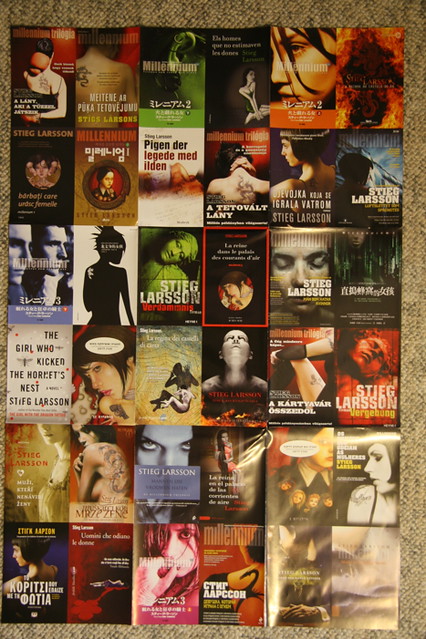
The British edition (unlike the Knopf edition) also came with a wall poster containing images of 36 different covers of the novels created by foreign publishers. More than 65 million copies of the novels have been published in hard copy, and well over a million copies for the Kindle have been purchased:

IMG_2745

Not only are books beautiful themselves, repositories of books are as well. For Christmas, my son David gave me a gorgeous volume titled The Most Beautiful Libraries in the World (Abrams, 2003). It contains breathtaking large-format photos of some of the most beautiful and thoughtful "buildings" constructed throughout history to store the collected knowledge and art of man.

This is a foldout spread of the Great Hall in The Abbey Library of Saint Gall in Switzerland:

IMG_2743

And a closer look at two of the panels:

IMG_2744

I sent David the following reflections after my first perusal of this book:

1. In the non-American libraries, where collections are much older, imagine the labor that went into the binding BY HAND of these millions of volumes. Even though the printing press came online around 1455, books were still bound by hand, right? And not just the binding, but the gilding and lettering on the spines, etc. The man-hours represented by the binding of millions of volumes is staggering -- all for the preservation of knowledge.

2. Again, in the non-American libraries, I was struck by the admixture of art and literature. Libraries could have been sterile warehouses with shelves -- just a place to catalog and store books. But they were stored in the equivalent of palaces and cathedrals. The libraries themselves represent the height of art, sculpture, and architecture of their day. It speaks well for how books (and manuscripts and music scores and important papers) were viewed -- on a plane with royalty and deity, so ornate and thoughtful were their places of storage.

3. The contrast between American and European libraries. I think only two American libraries are featured -- the Library of Congress and the Boston Athanaeum. Purely from the perspective of the photos of the books on the shelves, the American library books are smaller, newer, less ornate than the books in the European libraries. That's obvious and easy to explain, of course -- America is a younger nation, etc. But it must also say something about the intellectual history of the two cultures -- our libraries look "lighter" than the European libraries. More than once, in looking at some of the European libraries, I thought, "That's what the library at the Biltmore House (Asheville) looks like." . . . It's because George Vanderbilt basically imported books from Europe (as he did furniture, tapestries, art, etc for the house) that it looks so much like a European library.

Solomon had it right: "Of making many books there is no end" (Ecc. 12:12). And it's a shame that they (save one) will wilt before the renovating flames yet to come. The destruction of the great Library at Alexandria in 48 B.C. (thanks, Julius Caesar), where much of the accumulated knowledge or the world was stored, is a warning to all who would hold books too tightly.

But while we have them, they are a pleasure to have and hold.

The Role of the Home in Making Practical Men

"A distinguished American writer says: 'The training and improvement of the physical, intellectual, social, and moral powers and sentiments of the youth of our country require something more than the school-house, academy, college, and university. The young mind should receive judicious training in the field, in the garden, in the barn, in the workshop, in the parlor, in the kitchen—in a word, around the hearthstone at home. Whatever intellectual attainments your son may have acquired, he is unfit to go forth into society if he has not had thrown around him the genial and purifying influences of parents, sisters, brothers, and the man-saving influence of the family government. The nation must look for virtue, wisdom, and strength to the education that controls and shapes the home policy of the family circle. There can be no love of country where there is no love of home. Patriotism, true and genuine, the only kind worthy of the name, derives its mighty strength from fountains that gush out around the hearthstone; and those who forget to cherish the household interests will soon learn to look with indifference upon the interests of their common country. We must cultivate the roots, not the tops. We must make the family government, the school, the farm, the church, the shop, the agricultural fairs, the laboratories of our future greatness. We must educate our sons to be farmers, artisans, architects, engineers, geologists, botanists, chemists—in a word, practical men. Their eyes must be turned from Washington to their States, counties, townships, districts, homes.'"

The originator of these words is identified only as "a distinguished American writer," quoted by Edmund Morris in his circa 1867 book, Farming for Boys. (Italics in the original.) The book is being serialized in Small Farmer's Journal. This quote is from Part VI, Chapter XIV, of the book reproduced in SFJ, Winter 2012, Vol. 36, No. 1, pp. 34-38.

When I read this quote I was struck by the absence of such a worldview in modern literature. I read a lot, and these words jumped out at me as being from a different era. But regardless of era, they convey a settled way of thinking about life that is missing from postmodern thinking: the source of true education, the purpose of the home, how boys learn to be men, the intended distant influence of Washington, and others. Some will rail against pre-modern (1867) writing that excludes "girls" from the focus of training in the home. Note that this is a book titled Farming for Boys. If this author's point was to outline a system of industry for boys, the outline of a similarly vigorous industry for girls could be gleaned from Proverbs 31:10-31.

Friday, January 20, 2012

Chillun'

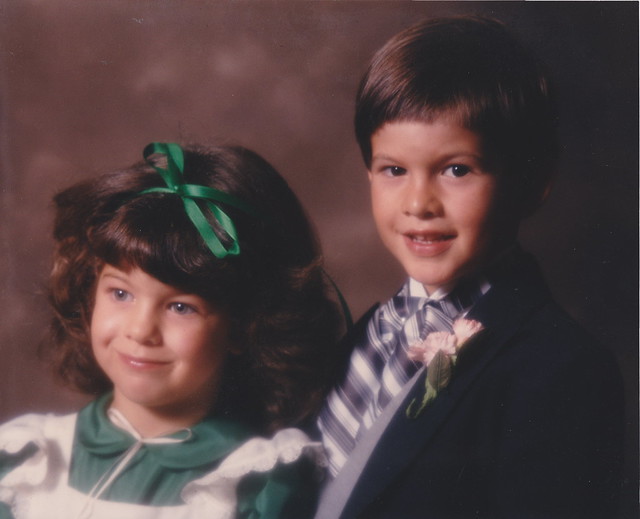
Ran across this sweet photo of two of my children the other day—Stephen and younger sister, Elizabeth. They were both participating in a wedding (early-mid 1980's) and were snapped by the wedding photographer. I only had the hard copy 8x10, and scanning it reduced a bit of the color—but not the soft effect the photographer used.

LizStephen

Thursday, January 19, 2012

Citizen Legislators

On January 12, Representative Tim Johnson of Illinois issued a press release announcing the introduction of the Citizen Legislator Act in Congress. His goal is to return the Congress to the idea of citizen, rather than professional, legislators. The following are key elements of his bill:

Limits days in session to five per month or 60 business days per session.

Halves the salary of Representatives and Senators.

Permits members to have jobs outside of Congress so long as they do not derive their income as a result of the privilege of their office, such as speaking tours, lobbying, consulting, etc.

Allows members to choose benefit plans to reflect their lower salaries and allows them to opt out completely for a private option.

Cuts member office allowances, committee and leadership budgets in half.

Prohibits any grandfathering out of the new salary requirements and benefit packages for current members.

Cuts member salaries an additional 10 percent for every five business days Congress exceeds 60 business days in a session.

Given the fact that our current legislators would be voting to reduce their own pocketbooks, perks, and power if they voted for this bill, the chances are slim it will make it out of committee. And given the fact that life in 2012 is a lot more complicated than in the 1780's, Johnson's specific recommendations may be unrealistic. But it's definitely a step in the right direction. After all, anything would be an improvement over the Congress we have now. (Read more about the Act at Rep. Johnson's web site.)

Apple Trailers Speed Boost

I'm a big fan of the Apple movie trailers web site for keeping up with new movie releases. Each trailer has three streaming options (format sizes) plus four download options. The three streaming options are Automatic (smallest format), 480p (next largest format), and 720p (largest streaming format).

Traditionally, I have always used the 480p format since the 720p format took too long to stream an adequate buffer before play would begin. But a week or so ago I noticed that the 480p stream had slowed to a crawl; it was basically unusable. I had to revert to the small Automatic option just to watch a trailer without waiting forever for the stream to buffer in 480p. The problem seemed to be isolated to the Apple trailers since no other web sites suffered from slowdowns.

But today, things are different. The entire 480p stream now downloads in a few seconds, and the 720p is so fast that playback begins almost immediately. I can now watch trailers in the HUGE 720p HD format that I couldn't before.

I can only assume that the temporary slowdown was due to Apple working on the servers that deliver the streams (?). And that the huge speed boost is due to some streaming upgrade on their end. If anyone has a better explanation, let me know.

Friday 1-20-12 UPDATE: Friday evening, streaming of trailers has reverted to the former sluggish rate described above.

Wednesday, January 18, 2012

USSC to POTUS: "Butt out!"

In a rare unanimous decision (all the more significant in this case), the U.S. Supreme Court told the President of the United States to take his hands off the internal functions of churches in America. The government claimed that a Lutheran church exercised "employment discrimination" when it terminated the services of its minister. No so, the Court said unanimously. Here is part of Chief Justice Roberts' opinion: (Link)
“Requiring a church to accept or retain an unwanted minister, or punishing a church for failing to do so, intrudes upon more than a mere employment decision. Such action interferes with the internal governance of the church, depriving the church of control over the selection of those who will personify its beliefs. By imposing an unwanted minister, the state infringes the free exercise clause, which protects a religious group’s right to shape its own faith and mission through its appointments. According the state the power to determine which individuals will minister to the faithful also violates the establishment clause, which prohibits government involvement in such ecclesiastical decisions.”

Doing Vegan Right

James McWilliams is associate professor of history at Texas State University, San Marcos, and a frequent writer on food matters—and a vegan. In this excellent The Atlantic article—"The Evidence for a Vegan Diet"—he responds to numerous recent articles by foodies who bewail their failed attempts to thrive on a vegetarian or vegan diet. His point: You have to do it right. Besides the abundant scientific data supporting the benefits of a plant-based diet, stories of people who did it right and transformed their lives are powerful.

This is an excellent article. I especially love his opening paragraph:

Here is a comprehensive list of what I ate, in one form or another, on the day I wrote this:

Kale, mustard greens, carrots, celery, onions, mushrooms, quinoa, amaranth, pinto beans, beets, parsnips, turnips, yellow peas, brown rice, kimchi, purple cabbage, butternut squash, blueberries, a banana, hemp seeds, flaxseed oil, snap peas, an apple, cashews, almonds, pumpkin seeds, pistachio nuts, garlic, broccoli, raisins, granola, avocado, polenta, salsa, a few saltines, a piece of raisin toast with apricot jam, tofu, coffee, olive oil, harisa, chickpeas, tomatoes, a small handful of chocolate chips, a couple of beers ... and a vitamin.

Tuesday, January 17, 2012

How to Get People to Give Blood

In his delightful memoir, A Year in Provence, English author Peter Mayle tells how he and his wife gave blood in their village to help a desperately ill child. I have written in this space on my experiences giving blood to the Red Cross where I live. If the Red Cross followed the French model—at least the way they do in the town of Gordes—they'd probably get a lot more donors:
In England, the reward for a bagful of blood is a cup of tea and a biscuit. But here, after being disconnected from our tubes, we were shown to a long table manned by volunteer waiters. What would we like? Coffee, chocolate, croissants, brioches, sandwiches of ham or garlic sausage, mugs of red or rosé wine? Eat up! Drink up! Replace those corpuscles! The stomach must be served! A young male nurse was hard at work with a corkscrew, and the supervising doctor in his long white coat wished us all bon appétit. If the steadily growing pile of empty [wine] bottles behind the bar was anything to go by, the appeal for blood was an undoubted success, both clinically and socially.

Some time later, we received through the post our copy of Le Globule, the official magazine for the blood donors. Hundreds of liters had been collected that morning in Gordes, but the other statistic that interested me—the number of liters that had been drunk—was nowhere to be found, a tribute to medical discretion.

Sunday, January 15, 2012

Uke Revival

In the early part of the 20th century, ukuleles were everywhere, having not yet been displaced by guitars as the most popular stringed instrument. The Martin guitar company made thousands and thousands of ukes—so many that they didn't even give them serial numbers which makes the vintage models hard to date and value today. But Martin stopped making them eventually when their popularity waned.

But a genuine, power-and-fire ukulele revival is under way. Martin started making them again a few years ago and now can't keep up with orders. And with Martin cranking them out again, boutique builders are cashing in as well, and popular rock 'n roots musicians are adding them to their repertoire (Dave Matthews, Eddie Vedder, Mumford and Sons, et al).

The hottest boutique uke builder right now is Mya-Moe Ukuleles in White Salmon, Washington, a husband-and-wife team (with a couple helpers) that is building drop-dead gorgeous instruments. You have to see the woods to believe them—here and keep clicking through them 600 plus ukes in the gallery.

Here's Irish singer-songwriter Lisa Hannigan doing one of her songs with her Mya-Moe:

Friday, January 13, 2012

Brevity

Blaise Bascal, the French polymath, is supposed to have once written, "I have made this letter longer than usual because I lack the time to make it shorter."

This counterintuitive statement illustrates what most of us know from experience (and what Strunk and White teach in The Elements of Style): It's much harder to write fewer words than more.

Put another way, writing is really rewriting and editing (cutting). I certainly violate the "less is more" principle in this blog (and conversation) but cannot afford that luxury in my work—as I have learned the hard way: A book contract once called for 80,000 words and I turned in 104,000—and was asked to cut 24,000 words. (In my defense, it was a marketing issue: The manuscript I turned in would have been more expensive to print and would have raised the cost of the book, hurting sales. Welcome to book publishing!)

For several years, I have written a series of pieces for a client that have to be exactly 130 words in length. Sometimes I turn in 129, sometimes 131—but 130 is the target. By the end of today I will have written 1,164 of these pieces, or a total of (approximately) 151,320 words. (That's enough words for a nice two-volume set on the history of something. It also demonstrates that the impressive two-volume history of something you've longed to write can be done—130 words at a time.)

Writing to an exact word count has been a great teacher. With word-count functions available in word processing software today, writing for an exact word-count target is a greatly under-utilized teaching tool. If teachers would assign their students the daily task of writing "your number one goal for today in exactly 17/23/29/31 words"—or some similar, short exercise—they would go a long way toward teaching students how to write well; how to choose, substitute, eliminate, and prioritize their words.

Just a thought.

(Delete that last line.)

Tuesday, January 10, 2012

Twelve Percent Less in Five Years

Mark Bittman, food columnist for The New York Times, talks about the reasons for a great trend in the U.S.: meat consumption is down 12 percent in the last five years. His conclusion: It has nothing to do with availability, prices, or any other external reason. Rather, people are eating less meat because they are choosing to eat less meat. Link.

Thought for the Day 16.0

From Seth Godin's blog:

One option is to struggle to be heard whenever you're in the room. Another is to be the sort of person who is missed when you're not.

The first involves making noise. The second involves making a difference.

Thursday, January 5, 2012

At Least I Wasn't Texting

I had a two-hour drive on the freeway last night and had my camera with me so took a few time exposures of trucks passing by. Is it against the law to take pics while driving . . . yet?

IMG_2714

IMG_2717

Wednesday, January 4, 2012

Vegan Body Builders

New York Times article on vegan body builders here. (Thanks, Stephen.)

Monday, January 2, 2012

National Treasures

For the last several years, I have waited religiously for the broadcast of the annual Kennedy Center Honors awards ceremony. It is the best two hours of television I know of.

The Kennedy Center in Washington, D.C., honors five members of the artistic community—music, comedy, dance, theatre, film—in a gala ceremony that celebrates their achievements. Even if I am not already familiar with, or a fan of, each nominee's work, the 20 minutes devoted to each is an incredible, and always moving, introduction to their work. They are honored with a short movie retrospective of their work, then by performances by their peers that illustrate their achievements. It's a black tie event and the audience is filled with all manner of recognizable artists who come to honor their friends and peers.

The ceremony is held in the fall and broadcast a few weeks later on CBS. The production value is of the highest quality and a pure pleasure to watch. It is a celebration in the truest sense of the word. The productions seem to get better every year -- yet I rarely hear them mentioned by John Q. Public. I think lots of folks are missing something special. (There are tons of YouTube segments from past Kennedy Center Honors presentations.)

The 2011 awards went to saxophonist Sonny Rollins, Broadway actress Barbara Cook, singer-songwriter Neil Diamond, cellist Yo-Yo Ma, and actress Meryl Streep. There is always one representative from the "popular" music field that really gets the crowd on their feet, and this year it was Neil Diamond.

Following is the segment of this year's show honoring Diamond featuring performances by Rafael Saadiq, Jennifer Nettles, Lionel Ritchie, and Smokey Robinson. A couple of things that will help you enjoy the last song, "Sweet Caroline," that won't be immediately evident: "Sweet Caroline" is sung in the middle of the 8th inning at all Boston Red Sox home games, and it was inspired by Caroline Kennedy, the host of the honors show, when Diamond saw a picture of her when she was a little girl. You'll understand when you see it. Enjoy . . . and tune in next year! (And hats off to Meryl Streep for her engagement with every moment of the performances—not just Neil Diamond's, but all the honorees.) (There's a 2-3 second blank space in the video, but it continues.)

Sunday, January 1, 2012

If You Don't Laugh out Loud at This . . .

If you don't laugh at Fred Armisen's question (he of Saturday Night Live), you probably don't laugh at The New Yorker cartoons either. My first thought after reading this—after laughing out loud—is that it would make a great New Yorker cartoon. See the whole newyorker.com article here.
This week, Margaret Talbot writes about Carrie Brownstein and Fred Armisen, the comedic masterminds behind IFC’s “Portlandia.” We sent Gabriele Stabile to photograph the pair in New York. “Fred’s apartment has wonderful northern light, beautiful views of the Upper West Side, and an unbelievable vacuum-cleaner robot,” Stabile said. “One of the publicists showed up at the shoot eight and a half months pregnant, and Fred asked, ‘Does your husband know?’ When you’re around people who are seriously funny you realize how bad your jokes are.” Here are a few outtakes from Stabile’s shoot.

Thursday, December 29, 2011

Thought for the Day 15.0

Once plants and animals were raised together on the same farm --
which therefore neither produced unmanageable surpluses of manure, to
be wasted and to pollute the water supply, nor depended on such
quantities of commercial fertilizer. The genius of American farm
experts is very well demonstrated here: they can take a solution and
divide it neatly into two problems.
-Wendell Berry, farmer and author (b. 1934)

Friday, December 23, 2011

Fans and Their Objects

Nobody writes better, more sensible songs—and plays a more-muscled, yet articulate, acoustic guitar—than Darrell Scott. His Kentucky holler roots feed his songs and create a knowing rapport with his fans. I would love to have been part of the audience at this intimate performance of one of his best— "It's a Great Day to Be Alive." It must be so heartening for singer-songwriters to realize that their fans know the words to their songs.


In the song above, Scott plays a lovely koa Taylor guitar, but in this one he plays one of Stefan Sobell's gorgeous acoustics. He is a fabulous guitar player!

It's No Wonder . . .

It's no wonder thousands and thousands of women read Dee Drummond's blog every day (and some men, like me). She writes, and lives, "funny" and "funnier."

Why I Like FORBES

I like Forbes magazine for many reasons, and have for years. The magazine is not afraid to integrate a biblical worldview into their capitalist commitments, knowing that only capitalism allows the creation of excess to fuel charitable and other non-profit efforts. (As is often said, capitalism is the worst system in the world—except for all the others.) They print a favorite Bible verse, sent in by readers, on the back page of every issue. Rich Karlgaard, the publisher, is an active churchman who often mixes his spiritual insights with his business sense in his editorial column.

And they are willing to publish articles like this: "The Christmas Conspiracy: Spending Less = Giving More" by Keith Levy—an article that champions movements like Advent Conspiracy and Living Water International:

Thursday, December 22, 2011

English Christmas

Thursday, December 15, 2011

Amazed Again

I posted this video back on February 3. I recently emailed the link to a friend (we were discussing a magic trick) and in the days following I got tons of blog visits from people that he shared the link with and who they shared the link with, etc. It really is an entertaining magic trick if you missed it back in February. Just for fun, if you like it send the link to some friends so I can see how the virus spreads over the next few days. Once people see this they seem compelled to send it to friends: "Hey, watch this!" (P.S. I saw a video on YouTube that explains how the guy does the first trick -- and here's how he does the card trick.)

Wednesday, December 14, 2011

Tuesday, December 13, 2011

Best Way to Spend a Half-hour a Day


Saturday, December 10, 2011

A Gaggle of Angels

I'm not sure what a group of angels is called—a multitude, a host, a flock, a gaggle? I kind of like gaggle so I'll go with that.

These gorgeous paintings of angels are by the wonderful artist Jane DesRosier (until recently of North Carolina, now Washington state). Actually, these are prints of her original paintings (couldn't have afforded the originals even if they'd been available). Six of them were mounted on birch plywood when I bought them from Jane, and four I mounted following her instructions. I think they are captivating—so reflective of the different personalities angels surely have.

Here's the group before I got them up on the wall:

IMG_2632

And here are some close-ups—Jane does incredible amounts of layering and texturing; the colors are so deep. If you look closely on the third picture below you'll see a portion of Scripture text that's been layered into the paint:

IMG_2641

IMG_2639

IMG_2640

IMG_2642

IMG_2647

IMG_2646

And here they are grouped on the wall (I could have used some art direction here, but did the best I could):

IMG_2663

IMG_2661

I've posted this beautiful video of Jane in her studio before, but I'll post it again here so you can see this amazing artist at work painting "Jesus and Mother" (accompanied by Patty Griffin's song "Mary" -- gorgeous): Link. (Warning: when you land on the page, scroll immediately to the bottom of the page and turn off the music that plays automatically as it will conflict with the music in Jane's speed-painting video.

And here's another artist's (Katherine Labbe) portrait of Gritty Jane (as Jane DesRosier is known) herself—it looks a lot like her!


Thanks to God for Jane's great talent and to Jane for sharing it abundantly.

Saturday, December 3, 2011

Winter Greens

Stopped by the Matthews Farmers Market this morning and came home with some beautiful winter greens: two bunches of collards, a bunch of regular spinach, two bunches of Bordeaux spinach (red stems), a giant head of Romaine lettuce and a head of red leaf lettuce. The temp was in the mid-30's this morning (lower overnight), and our local organic growers are still producing this beautiful produce:

IMG_0026

I've been fortunate to have an abundant supply of Swiss chard growing in my own front bed. These chard plants are all from seeds from a plant that went to seed last year. I picked a leaf 21" long the other day (the leaf only, not counting the stem) and 10" wide to make a wrap for lunch.

IMG_0028

IMG_0031

Friday, December 2, 2011

Steve Jobs: Postmortem

One of America's best-known plant-based doctors, Dr. John McDougall, did a significant amount of research on Steve Jobs and the cancer that killed him, and offers some reflections on what caused his death—his vegan diet likely kept him alive longer than he might otherwise have lived, and the surgery he regretted not having sooner would not have saved him. Link.

Tuesday, November 29, 2011

What Are We Paying You For?

Monday, November 28, 2011

How to Google

Great primer on how to use Google to search for maximum advantage—including using Google to perform math functions and metric/standard conversions. Here.

Sunday, November 20, 2011

Oops! Chris Matthews Has Gone off the Reservation

Thursday, November 17, 2011

Bicycle Friendly

Here's a great idea arising from a great story:

The cycling team at Lindsey Wilson College in Columbia, Kentucky, takes regular, long training rides on the roads surrounding the college. They were approached by some local residents who said (paraphrasing), "We like seeing the cycling team come by on their training rides and would like to support the team. We'd like them to know that if they ever need any assistance, especially in more rural areas—food or water, a phone, medical or mechanical help, directions—they are free to knock on our doors and we'll help them any way we can."

So together, they came up with the "Bicycle Friendly" sticker above. It's large—about 6" in diameter—to affix to the mailboxes of homes that are "Bicycle Friendly." When cyclists see the sticker, they know there are "friendlies" living there who will welcome the opportunity to assist them if they need help. And local businesses have gotten on the bandwagon—coffee shops, restaurants, and others who welcome cyclists are displaying the stickers on their storefronts.

In a day when cyclists are viewed as a nuisance by many folks, it's encouraging to find people who, even though they don't ride themselves, are still "Bicycle Friendly."

You can learn more about the program here, and order your own "Bicycle Friendly" stickers for your own mailbox or storefront. Ordering info is on the web site, or you can send a PayPal payment to grigsbyd@lindsey.edu. Stickers are $1 each and $1 for s/h for every 25 stickers ordered. That's obviously a break-even price, but proceeds support the Lindsey Wilson College cycling team. I've ordered some and plan to take a few by the two bike shops near me to encourage them to participate in distributing them.

They've already sold the first run of 10,000 stickers with more on order!

Wednesday, November 16, 2011

Needed: Economic Freedom

John Mackey, CEO of Wholefoods, has a great Wall Street Journal opinion piece on the need for economic freedom in America—i.e., economic reforms that would get the American economy moving again. From his editorial:
So why is our economy barely growing and unemployment stuck at over 9%? I believe the answer is very simple: Economic freedom is declining in the U.S. In 2000, the U.S. was ranked third in the world behind only Hong Kong and Singapore in the Index of Economic Freedom, published annually by this newspaper and the Heritage Foundation. In 2011, we fell to ninth behind such countries as Australia, New Zealand, Canada and Ireland.

Friday, November 11, 2011

How Apple Makes Money

Apple's secret weapon for making money is to control the supply and production chain—from manufacturing to retail. A Bloomberg Businessweek article provides a jaw-dropping look at how Apple controls how its products are built, shipped, and sold. Just amazing.

Thursday, November 10, 2011

When College Presidents Were Eloquent

In his November 9 column, George Will discusses the financial power of college football—how teams are switching conferences, and traveling thousands of miles cross-country for games, in pursuit of ever-larger television and bowl appearance payouts. As a contrast to the current state of affairs, he cites the refusal of Andrew Dickson White, Cornell University's first president, to allow Cornell's football team to travel to Cleveland to play Michigan's team in 1873:

"I will not permit 30 men to travel 400 miles merely to agitate a bag of wind."

That's the kind of elocution one expects from a college president!

Wednesday, November 9, 2011

How Cats Use Computers

My daughter and her cat, Trina, are bunking with me temporarily after relocating here for a new job. Here is how Trina uses my daughter's iBook—as a be-hind warmer, apparently. If Trina was a Lab, a Vizsla, a German Short-haired Pointer, a Weimaraner, or Rhodesian Ridgeback, she would have had the computer open reading Drudge, making trades, or setting up a night of poker with her pals. But not Trina. As far as she knows, the white plastic thing is a hotplate just for her. Cats.

IMG_3310

Tuesday, November 8, 2011

The Ultimate Tweaker

If you don't have time (or interest) to read the just-released 600-page biography of Steve Jobs, a condensed version of Job's personality is at The New Yorker here. It's a quick read, but captures the darker side of the man who many know only as conquering hero. I confess to feeling much differently about Jobs after reading the biography. Before the book, I saw him as a genius with quirks. After the book I saw him as a deeply flawed man who I wonder if I would have enjoyed knowing.

This article uses the paradigm of the English Industrial Revolution as a way to think about Jobs. He was not an inventor but a tweaker—the most obvious example being his implementation of the technologies developed at Xerox's PARC center that appeared in the first Macintosh, and which the world thought Jobs & Co. had invented: the GUI (graphical user interface), the mouse, and more. There were portable music devices and cell phones before the iPod and iPhone—but Jobs tweaked what existed and made it great. And drove people crazy in the process.

He was such a perfectionist that it took eight years for him to begin furnishing the house he and his wife bought—he insisted they discuss the "purpose of a sofa" for a long time before buying one. Same with a washer and dryer. In the hospital he rejected nearly three score nurses before he found a couple he could tolerate, also rejecting the oxygen mask and finger BP sensor because of their poor design. These and MANY other examples are in the book—and there are enough in the New Yorker article to flesh out an accurate picture of the man.

Perhaps the saddest example of his perfectionism came near the end of the life (this story is in the biography, not in the article): He only got half-way toward deciding whether there is a God or not. In one of his final interviews with his biographer, Walter Isaacson, Jobs said he wasn't sure about the existence of God. He figured there is a "50-50 chance" that God exists. Taking eight years to decide about furniture is one thing. But taking a lifetime to decide about the existence of God is a far more weighty gamble—and an unnecessary one in light of the evidence:
"But the basic reality of God is plain enough. Open your eyes and there it is! By taking a long and thoughtful look at what God has created, people have always been able to see what their eyes as such can't see: eternal power, for instance, and the mystery of his divine being. So nobody has a good excuse." (Romans 1:19-20, The Message)
I can only hope that Job's perfectionism—the demands that he made on those around him—didn't carry over to his contemplation of the existence of God right up to his final moments of life. The verse just quoted says there is enough evidence to decide. But perhaps not enough for those who demand complete compliance to their standards.

Monday, November 7, 2011

African-Americans, Diabetes, and Veganism

The American Diabetes Association says that 14.7 percent of African-Americans over the age of 20 have diabetes. A new study from Loma Linda University found that vegan African-Americans have a 70 percent reduced risk of being diabetic, while lacto-ovo African-American vegetarians (those who eat dairy and eggs but not meat) have a 53 percent reduced risk of being diabetic.

With the Centers for Disease Control saying that one-third of American adults (all races) could be diabetic by 2050, you wonder why this vegan/vegetarian solution is not being shouted from the government rooftops. Can you spell m-e-a-t a-n-d d-a-i-r-y l-o-b-b-y ?

Read the article here. (Thanks, Daniel)

How to Change Your Genes

Great Atlantic article summarizing some research on the effects of lifestyle on genes. In short, poor lifestyle choices (e.g., smoking) can make good genes go rogue, but people with genetic markers for, say, heart disease can greatly decrease the likelihood of the disease through things like exercise and eating more fruits and vegetables. The idea that our health and longevity are genetically predetermined and outside our control is no longer viewed as correct.

Summer Camp

If you're in the market for a summer retreat in the beautiful Adirondacks of upstate New York, you'll want to check out this unbelievable offering from Sotheby's—a collection of rustic structures on 42 acres on a lake, yours for $6.5 million. If you look at it for fun (I'm obviously not in the Sotheby's market), be sure to click on the various links (Interior, Exterior, etc.) to see more pics than those on the home page. Especially stunning are the pics taken at night showing the expanse of stars (the point is made that the nighttime pics are not Photoshop'd—that's really how it looks at night). The pic I've posted here is of the outdoor fireplace. Can you see yourself sitting around this on a brisk New York night? See it here.