Sunday, July 26, 2009

Back in the Compost Biz

Having closed down my rather involved compost-making operation a few years ago, I've been burying vegetable scraps in the flower beds since then (with good results -- pretty rich soil in the flower beds). But with all available space being taken up by summer veggie plants, I had resorted to just burying the scraps in the area where the compost bins used to sit -- not very productive, but I couldn't bear to throw them in the garbage.

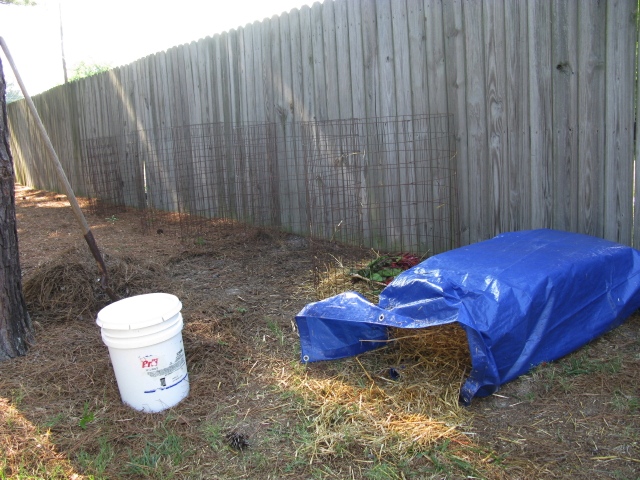
So today I used a couple rolls of wire fencing a neighbor had given me and created four new compost bins. I'll have a good many spent plants that can go into the bins as I pull up tomatoes, etc., toward the end of the summer. I had a big container full of veggie scraps to start with, so I made the bins and then got a bale of hay from Home Depot and started the first bin this afternoon. (The hay is, I'm sure, replete with pesticide residue. Sammy Koenigsberg uses large quantities of hay to mulch his plants, and since he's certified organic the hay he uses has to be organic as well. So I'll try to find out his source and get some to use going forward.)

The new compost outpost: The bins are a bit hard to see, but they're almost four feet tall and about 3.5' wide. The tarp is covering the hay bale to keep it from getting soaked in the rain. (What rain?)
IMG_1628

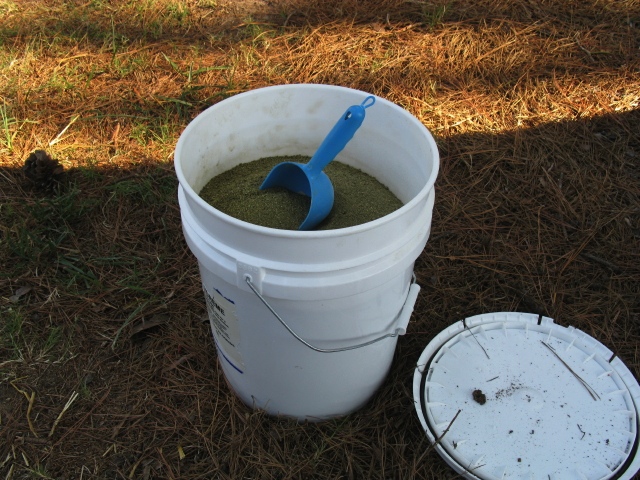
Organic alfalfa to use as food for the bacteria that decompose the green and brown matter in the pile:
IMG_1629

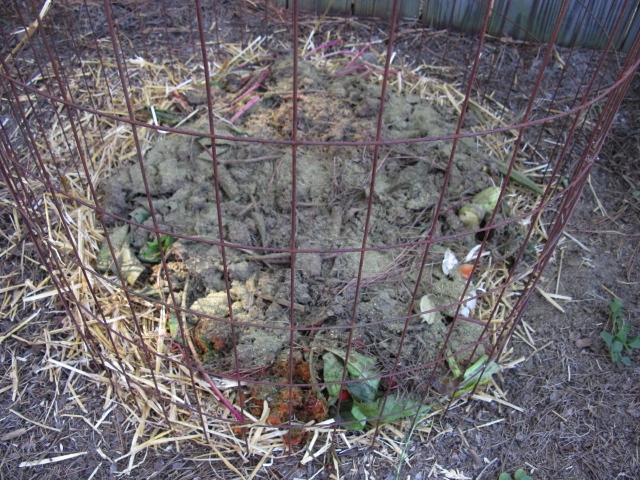
Started with a layer of straw on bare earth, then a layer of household veggie scraps, then a layer of soil to add microorganisms to the mix, then a sprinkling of alfalfa meal, then another layer of straw, then a soaking of water. This won't come close to heating up until many more layers are added and the pile grows in mass. But it's a start:
IMG_1631

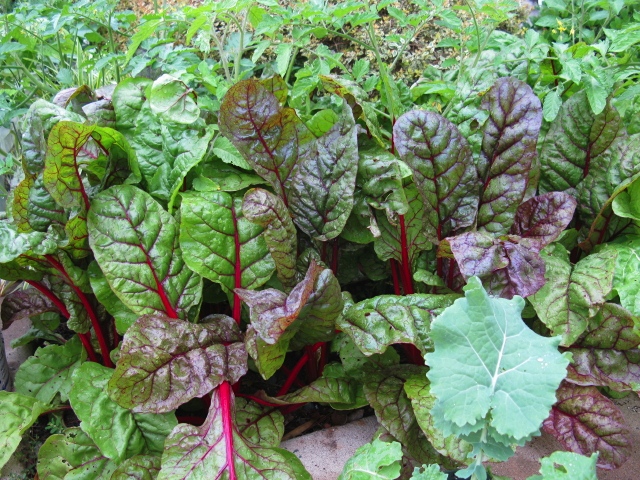
P.S. Here's today's juicing content. The red chard, beets, and curly green kale are from my beds. The beets were pulled previously, but the chard and kale I cut just minutes before juicing. Those long red chard stems are full of juice! Makes me feel like the juice is all the more nutritious when it is extracted just minutes after being cut:
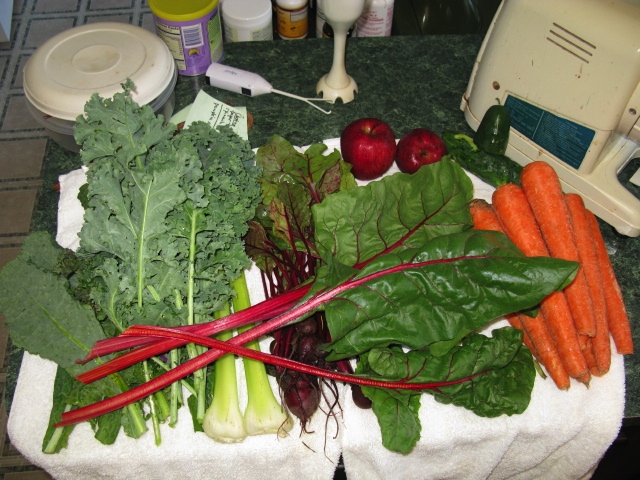
IMG_1627

Saturday, July 25, 2009

Forty Farmers Under Forty

Nice article here profiling the "young farmers" movement around the U.S., including popular singer/songwriter Jason Mraz who has a small avocado farm in California. Pictures and brief bios are included of each of the forty. What a great time to be young!

Friday, July 24, 2009

Some Weddings Are More Fun than Others


End of the Week Veggies

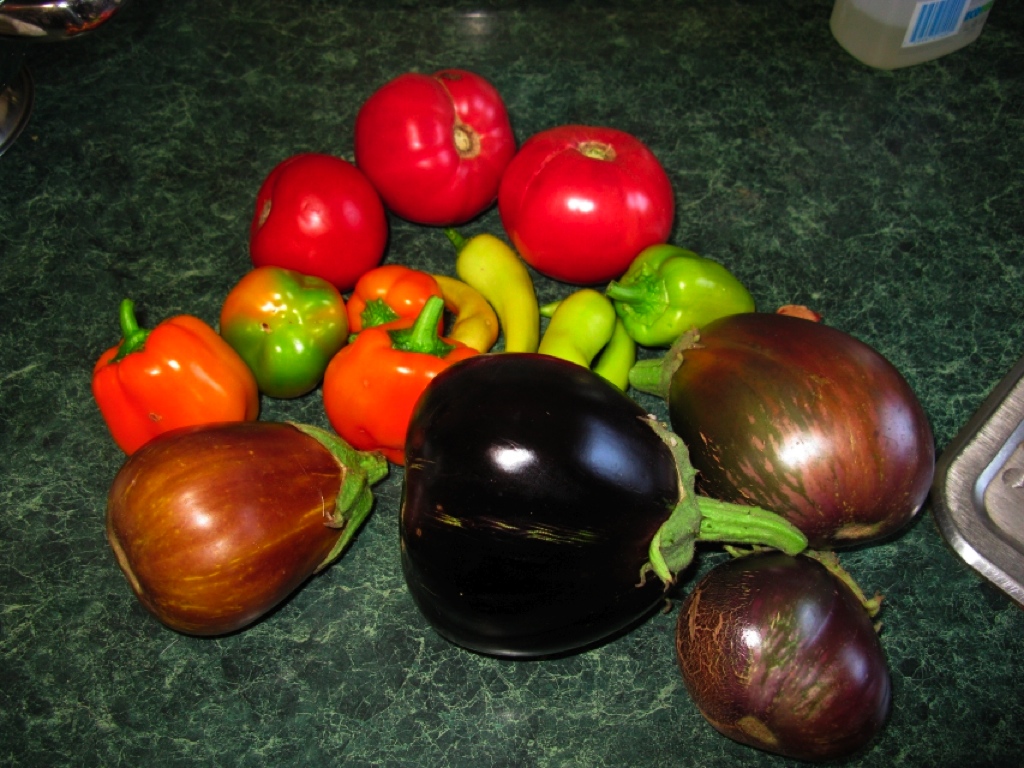
My too-small garden continues to offer up a bit 'o fruit. Not too sure about these eggplants—they seemed to have stopped growing so I pulled 'em. Hard as a rock. One of the things I enjoy most is standing around eating cherry tomatoes. I have several different kinds growing so it's a nice variety. I have a big basket of them on the counter which I never seem to be able to empty.

IMG_1625

Tuesday, July 21, 2009

Sammy's Veggies

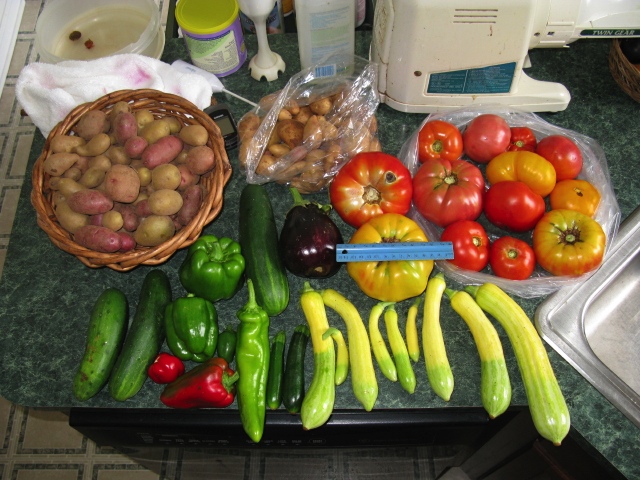
A quick pic of today's CSA goodies: several varieties of potatoes, baby squash and zukes, peppers, eggplant, cukes, and a bag of beautiful heirloom tomatoes -- notice the different varieties. I laid the 6" ruler across the top of one just to give an indication of their size. One slice out of the middle would cover a piece of bread for a summer tomato sandwich. (Note: the basket of potatoes on the upper left corner was not from today but from the last couple of weeks from the CSA share. Only the ones in the plastic bag are from today. I can't eat them fast enough!)

IMG_1621

I walked around in Sammy's gardens a bit before coming home and was just astounded at the sheer size of what he grows. Tomato plants 7-8 feet tall in a forest of vines. I don't even see how he gets down the rows to pick, so long and large have the vines grown horizontally, all dripping with fruit. And no sign of yellow leaves (wilt disease). Just amazing.

The summer squash leaves stand 4-5 feet high -- it looks like you could climb up on them and walk on top of the solid green surface of the leaves blending together. I have never seen yellow squash flowers so big -- as broad as a bread plate or soup bowl with bees trafficking in and out. I saw cucumber beetles (like ladybugs, but green with black spots) on the squash plant leaves but saw no damage to the plants at all.

The years Sammy has spent nurturing the soil on his farm have paid off. The plants he grows are hard to believe. Wish I had taken my camera.

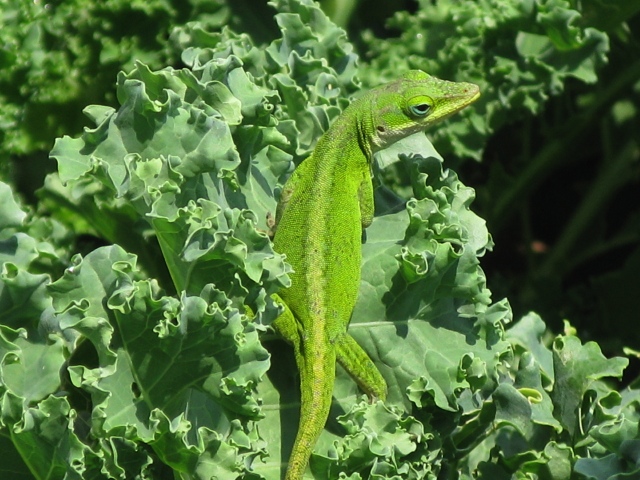
Caught this little guy sunning on top of the kale in front of my house:

IMG_1622

Wednesday, July 15, 2009

Reverence for Life

Albert Schweitzer (1875-1965) was a German theologian, musician, medical doctor, and philosopher (two earned doctorates, many more honorary). He was awarded the 1952 Nobel Peace Prize for his work on human ethics under the controlling rubric of "Reverence for Life." He had worked for years to arrive at a controlling theme that would unify humanity's responsibility to itself and the rest of creation, to no avail. He described how, in 1915, "I was wandering about in a thicket, in which no path was to be found. I was leaning against an iron door, which would not give before me . . . ."

In his 1933 (English edition) book Out of My Life and Thought he described how he found a path and how the iron door opened. He was in equatorial Africa, working as a missionary doctor among the natives. That same year—1915—he was required to travel 200 kilometers upriver on a slow steamer from the coast of Africa to attend to a sick missionary. On that slow trip his "Reverence for Life" epiphany took place:
Slowly we crept upstream, carefully picking our way among the sandbanks—it was the dry season. Lost in thought, I sat on the deck of the barge, struggling to find the elementary and universal notion of ethics, which I had not discovered in any philosophy. Sheet after sheet of paper I covered with unconnected sentences, just in order to keep my mind concentrated on the problem. At sunset on the evening of the third day, as we were passing through a herd of hippopotamuses, there came to me suddenly, unpresaged and unsought, the words "Reverence for Life." The iron door had given way; the path in the thicket had become plain. I had now forced my way to the idea in which world- and life-affirmation and ethics were both contained! Now I knew that ethical world- and life-affirmation, along with its ideals of civilization, was founded on thought. (From pp. 135-136 of Out of My Life and Thought, quoted in The Animal World of Albert Schweitzer—Jungle Insights into Reverence for Life, a collection of Schweitzer's writings, p. 165).
I first read this in 2003 and was moved by Schweitzer's idea of "Reverence for Life." It's biblical, practical, and all-encompassing. I was also reading at that time books by and about Dr. Max Gerson (1881-1959), the German medical doctor who discovered plant-based, nutritional healing therapies for cancer and other major diseases. Fleeing Hitler's Germany, Gerson came to the U.S. with his family where his nutritional protocols were shut-down and he was blacklisted by the American Medical Association in the 1940's. In 1949 Albert Schweitzer made his first visit to America to lecture and receive an honorary doctorate from the University of Chicago. On that trip, he quietly visited Dr. Gerson who prescribed a plant-based therapy that cured Schweitzer's Type-II diabetes. (Gerson had already healed Schweitzer's wife of tuberculosis and his daughter of a jungle-acquired skin disease with the same plant-based protocols.) This was when Schweitzer was 75 years old; following Gerson's plant-based diet, he lived until age 90, free of diabetes.

Reading about these two men—Gerson and Schweitzer—made a terrific impact on my thinking. Both amazingly brilliant, they struggled for years to find solutions to practical and philosophical issues that arose in their professional lives. And endured significant (Gerson) and sometimes (Schweitzer) opposition for their efforts.

I was reminded recently of Schweitzer's "Reverence" revelation when reading From My Experience—The Pleasures and Miseries of Life on a Farm, the last
(1955) of the 29 books of American novelist and farmer Louis Bromfield, who I profiled in an earlier post. I would put Bromfield's impact in his day in the same category as Gerson and Schweitzer (in whose "day" he lived). Indeed, Louis Bromfield's books on Malabar Farm and natural farming methods were read with great attention by Max Gerson (along with the works of American J. I. Rodale and British Sir Albert Howard) as he struggled to connect human health to the health of the soil—the health of the former being dependent on the health of the latter.

Near the end of his multifaceted life, Bromfield was searching for a purpose. He had lived expansively for decades as a writer and helpfully as a farmer developing natural techniques for reversing the ecologically destructive and unsustainable methods of farmers in his day. Near the end of his life he was, like Schweitzer had been a few years earlier on another continent, searching for a way to summarize his own tireless efforts to elevate plant, animal, and human life in all its dimensions. On a trip to Brazil, Bromfield had taken along Schweitzer's Out of My Life and Thought, having meant to read it previously. And when he came across Schweitzer's "Reverence for Life" revelation the loose ends of his own personal life and philosophy were suddenly tied together. The following excerpts describe Bromfield's own "eureka" moment as he read (picking up with his thoughts after reading the first half of Schweitzer's book):
It was only when Schweitzer, trained as a theologian and preacher, arrived at the point where he felt that he must do more than merely preach and teach within the orbit of Christian doctrine, that the book took fire. Here was something I could understand . . . a Christian who felt that he must do something tangible about being a Christian and decided that he could do most good and best satisfy his spirit by studying medicine and going into the work of actively and materially helping the more unfortunate members of the human race [in Africa]. It was at this point that for me the book began to have a real and significant meaning of great importance. . . .

As I read on in the pages Schweitzer had written often painfully, and frequently when he was ill and exhausted from the labors of his day's work, the book grew more exciting and impressive. It seemed to me that here I found a man who had not only realized the talents and potentialities with which most men are endowed to some degree, but also a man whose philosophy was needed bitterly in this Age of Irritation and Frustration.

And then I came upon that passage which for me illuminated a whole new world of philosophy and religion and brought to me the clarification and the formalization of all the chaos which had been troubling me for years.

I will simply quote the passage in which Schweitzer created a phrase which provided me with the long-sough illumination. The scene is a barge on a river in the midst of Africa. [Bromfield then quotes the passage from Schweitzer's book I quoted above.]

In this very great phrase, "Reverence for Life," I too found what I had sought for so long. It explained not only my thoughts but the emotions and instincts which I had long experienced as a man. It is one of those phrases which, stimulating thought to an almost unbearable degree, illuminates the darkness like the switching on of a powerful light bulb—a phrase which is fecund and keeps breeding thought upon thought, conception upon conception upon conception. It was like the bursting of a rocket high in the darkness of the night air.

The phrase "Reverence for Life" brought the elements of the mechanistic and the material together with the ethical and even the spiritual, something that the church, in all its forms [as Bromfield knew it in his day], has long since been unable to do and the attempt at which it has apparently abandoned. It asserted the principle of affirmation rather than denial; it restored dignity to man. In a sense it defined God for the first time, for if God is not Life, He is merely a vaporous figment of the imagination and the delusion of the weak and the frightened and of those very weak and fearful and ignorant who are so profoundly in need of help not from God so much as from their fellow men who are stronger, more intelligent, perhaps even more favored. . . .

And still one more quotation [from Schweitzer] which touched me very closely: "A Man is ethical only when life, as such, is sacred to him, that of plants and animals as well as that of his fellow men, and when he devotes himself helpfully to all life that is in need of help."

I began to understand what it was that had taken increasing possession of me for fifteen years, indeed for nearly a generation, why I had committed what some of my fellow men regarded as follies but which were not follies at all, why I had poured out time and energy and money in very large amounts for things on which there could not possibly be any material return. It explained to me why I have rarely said no to life and to experience, and why my sense of sin is notably deficient by the standards of most church dogma; why I have always enjoyed to the full the five senses which are a part of the glory of life, why there were certain shabby things, certain cheating and short-cutting, I was never able to practice without a sense of degradation and the violation of principles which I until now have never fully understood or put into words.

There are things which one does or one does not do, and in his heart even the savage knows what these are, and each time one violates this principle, the individual becomes more brutalized and sinks a little lower, not only in the esteem of others but in the secret knowledge deep in his own heart—a knowledge which in time grows into a face which repels warmth and friendship and respect and makes of any man an outcast on sight from his fellow men, and above all from discerning, intelligent, and good men.

Michelet knew this when he wrote . . . "In damnation the fire is of little importance. The real punishment is the steady progression deeper and deeper into vice and crime, while the spirit grows steadily more calloused and more depraved, lost constantly in the evil of the moment in a geometric progression into eternity."
Without realizing it, Louis Bromfield (and French historian Jules Michelet) was describing (in part) what the apostle Paul describes in Romans 1-2—how every person has the law of God written on the heart, but when that law is repudiated over and over there is a "steady progression deeper and deeper" into depravity. God's judgment on such rejection of His ways is evident in how He allows man to suffer by his own doing now and by His ultimate, consummating settling of accounts at the end of the age. Surely many of mankind's modern afflictions are the result of our own "steady progression" away from God's design.

Modern man's lack of "Reverence for Life" is the point of these various half-century-old threads that I have identified and brought to bear here. The Holocaust that Max Gerson fled, the American dehumanizing of African slaves, the modern aborting of tens of millions of unborn children in America, and the inhumane treatment of non-human animals in our world all point to a radical deficiency in "Reverence for Life."

Though the Bible doesn't say so specifically, I have always thought that this verse in Genesis—"Now the earth was corrupt in God's sight and was full of violence" (6:11)—must be descriptive not only of man's violence toward man but man's violence toward animals as well. God's distaste for that violence led to the Great Flood and the fresh start fathered by Noah and his family. Sadly, we've done little better with our second chance. Few would deny that today's earth is "corrupt and full of violence" against man, beast, and the earth itself.

Which brings me to the point of this post: A movie was made a couple years ago which is only now gaining traction—or at least, I have only now heard about it. (My California son, Stephen, knows the producer/director and says it is well-known among his contemporaries, but I only learned about it recently.) Titled Earthlings, it is a 90-minute overview of man's lack of reverence and respect for the lives of non-human animals. It is at once the most graphic, and the most philosophical, of any films or exposés I've seen on the inhuman treatment of animals. Narrated by actor Joaquin Phoenix, with a soundtrack by Moby, the movie covers five areas in which animals are mistreated: pets, food, clothing, entertainment, and medical/military research.

It's interesting that Earthlings was released in 2005 and Al Gore's Oscar/Nobel-winning movie was released in 2006. Gore made no mention in his lecture of the number one contributor to environmental pollution: factory farming of animals for human consumption. This is a fact that the United Nations, the World Health Organization, and others have documented extensively. So why didn't Gore mention it? Probably because he was picking his battles and didn't want to run the risk of turning off a meat-eating world with a cut-back/abstain message on behalf of the animal kingdom. (My opinion, not the movie's.)

I said this movie is graphic—many people will not be able to watch it all the way to the end. But it simply illustrates the fact that "if slaughter houses were made of glass," or "if people had to butcher their own meat" most people would be vegetarians. In other words, animals no longer represent "life" to the average person, they represent "meat." The notion of "Reverence for Meat" seems silly, but that's what "Reverence for Life" has become. Most moderns—moral, well-meaning, intelligent, but woefully uninformed—have no idea how animals are actually treated in the five areas covered by this movie (animals for food being only one of the five, all of which are covered equally). It is brutal, inhumane, and sickening in many instances. Sadly, too many people don't want to know. Many will even be afraid of seeing a movie like Earthlings because of what it reveals. But for lack of grainy World War II footage, the Yad Vashem memorial in Jerusalem, Schindler's List, and other affronts to our consciousness, there might have been more than one Holocaust. So bad stories do need to be told—and heard and seen.

Because the movie had a hard-time finding a commercial distributor it is not as well-known as it might have been (in spite of being screened at several prominent film festivals). It was more than any distributor was willing to risk promoting. But it is being seen, slowly but surely, nonetheless. And I encourage you to see it. I can't speak for the producer/director's "anything"—I'm not recommending him or his organization. But after watching the movie, I am going to recommend it for the way it highlights how the modern world has lost its "Reverence for Life."

The movie can be purchased in standard DVD hi-res format, but it can also be viewed in its entirety on the movie's web site. Perhaps because of the length of the streaming, the audio and video get separated in the second half of the movie, but it is still intelligible. To watch the movie, go to this page and scroll down to the bottom and click on "Full Movie."

If you made it this far, thanks for reading, and I hope you'll view the movie. I hope it will encourage you to incorporate and extend "Reverence for Life" to the non-human animals that surround us.

Young North Carolina Farmers

The current issue of Mule magazine has an article about three examples of a growing breed of young farmers—individuals and couples—who are creating small (sometimes micro) farms, in this case right here in North Carolina. I've posted the "reader" below to highlight the growing technology of being able to read magazines online, and in this case to embed the article on a web site or blog. You can use the scale (percent) adjuster (and other tools) in the top margin of the frame to make the article more readable. Or if you'd prefer to read it online you can go here. If you don't read the whole article at least take a look at the nice photos. (Thanks to Chatham County, NC, [organic] extension agent Debbie Roos at Growing Small Farms for the heads-up on the article.) (Disclaimer: Mule magazine is not something I read regularly or recommend. This article is the first time I've heard of it. My recommendation is only for the article, not for the mag itself.)

Monday, July 13, 2009

Lovely Tomato

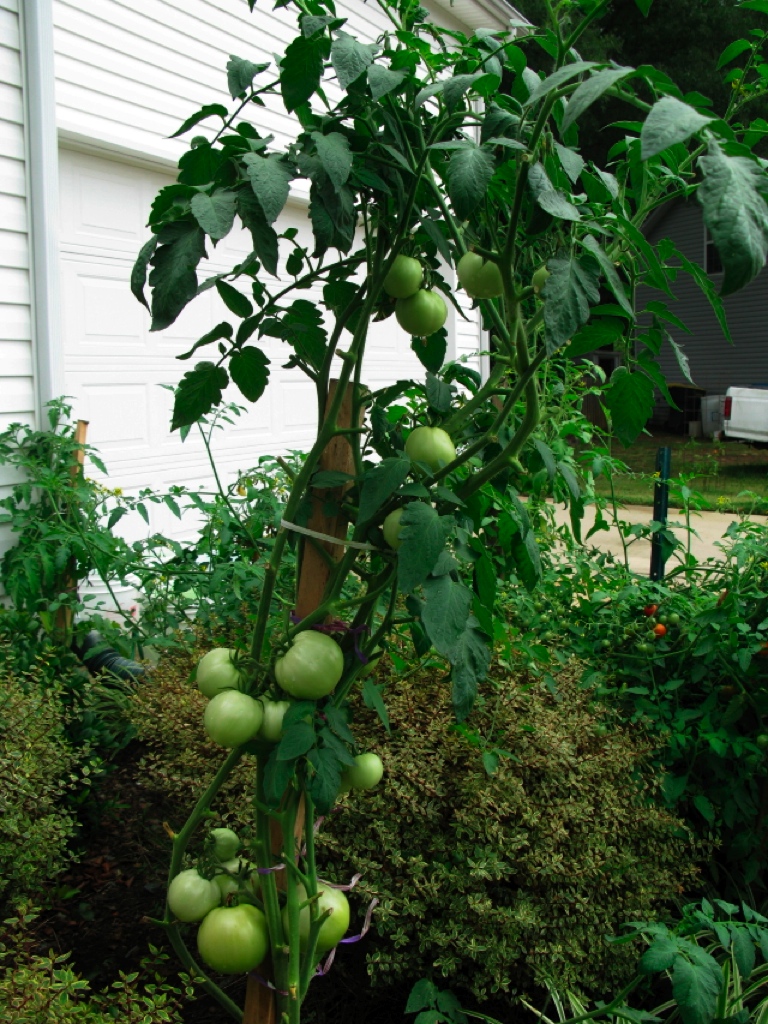
I've taken a lot of yard pics in the last couple of weeks but haven't had time to post them. So I'll put this one that I took this morning of my favorite tomato plant. I've kept the suckers trimmed off it and it has reciprocated by putting a lot of energy into fruit-bearing. I thought it was an heirloom Brandywine that I started from some saved seeds, but seeing its prolific output I'm not sure -- though it does have the large potato-type leaves of an heirloom. There are 19 tomatoes growing and no sign of the soil-borne virus that attacks tomatoes so frequently. I'll definitely save some of these seeds to try to duplicate it in the future.

IMG_1615

Sunday, July 12, 2009

How to Peel a Banana

Tuesday, July 7, 2009

Alone in the Midst of the Land

Found a striking contrast between these words from Isaiah 5:8 . . .

Woe to those who join house to house;
They add field to field,
Till there is no place
Where they may dwell alone in the midst of the land!

. . . and this description of the land surrounding Malabar Farm in Ohio in 1940 as described by Louis Bromfield's daughter, Ellen, in her book The Heritage, remembering the land as it was when her family first moved onto the property:
The road we followed was impassable to cars. Sheltered by the trees, its earth was always damp and cold, even in the drought of August, and in many places it was worn away to a bare shelf of sandstone and shale over which spring water trickled from somewhere deep in the earth. Walking along this road in the shade of the tall trees, one had the sensation of having come unexpectedly upon a part of a great, enclosed world which had avoided, or perhaps even defied, progress. It seemed almost as if the noise and clatter and brassiness of the modern age were prohibited here and, knowing this, one felt extremely grateful. At the top of that road, we passed through a sagging gate and came upon the great dome of wind-swept grass that was the Ferguson Place, high above the Ohio country. (italics added)

Friday, July 3, 2009

Baby Birds

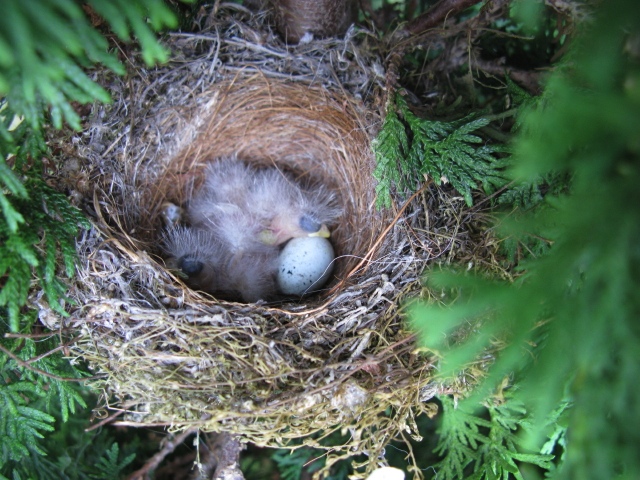
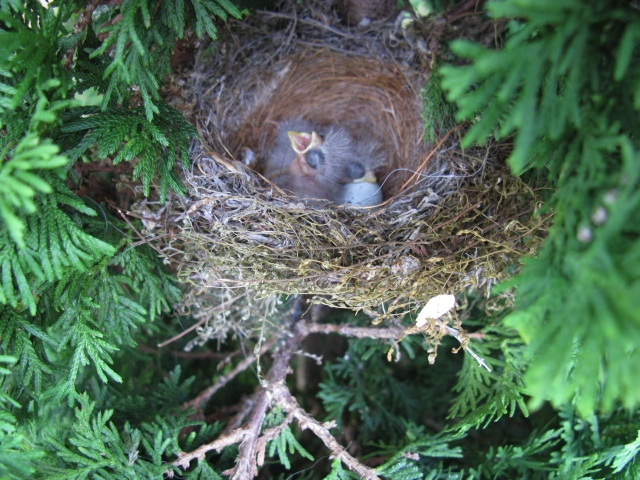
Discovered a bird's next in a tall evergreen shrub next to the house. Think how many individual items it took to weave that nest! Looks like two have hatched and one to go:

IMG_1612

IMG_1613

Thursday, July 2, 2009

You're Riding Along the Road in France . . .

Imagine the scene: You're in France to watch the Tour de France and (for fun) you're riding up one of the biggest mountains that the racers will climb during the race -- when you look up and there's Lance Armstrong coming up alongside. Armstrong was doing his normal thorough reconnaissance work, riding the mountain before the race to get familiar with it. Because he always has a car and video crew following him, he caught the surprised American cyclist on tape: (unfortunately, both videos begin playing automatically, so you'll need to stop one of them and play them separately)

(I later deleted the two videos because, annoyingly, they start playing automatically every time the blog is accessed, and slow the loading time for the blog, etc.)

3:20" Overview of Preventable Disease

I've blogged before about the annual invitation-only TED (originally stood for Technology, Education, Design) conference where the best ideas in education, technology, health, and related topics are presented by some of the world's most creative thinkers and researchers.

One of the speakers in 2006 was the famous Dr. Dean Ornish who was among the first to prove that cardiovascular disease was preventable and reversible by changes in diet (moving to a primarily plant-based diet) and lifestyle. This 3:20" video has an amazing graphic presentation on the rise in obesity in America, plus a ton of other salient facts -- along with a hilarious graphic picturing the ascent and descent of man. If your Internet connection will handle it, look below the video window for a link to a higher-res version of the talk for better viewing.

Reaping What We Sow


I am just now reading Silent Spring, the book by Rachel Carson that warned the world in 1962 about the dangers related to the toxic chemicals that were (and still are) so freely being administered to an oblivious world in her day. I am amazed at how thorough her research was then (she was a trained marine biologist) and how prescient and prophetic it appears now.

There is so much that could be quoted, but one particular section was particularly scary. She discusses the latency factor of carcinogenic chemicals—how effects (e.g., cancers) don't show up in many cases until years after a person has been exposed to carcinogens. She gives many examples from her own era (1950's - early 1960's), and then says this (remember, this book was published in 1962):

"The full maturing of whatever seeds of malignancy have been sown by these chemicals is yet to come."

Jump to 2009 -- I don't have time to look up today's exact predictions, but I have read in recent years that current estimates are that one in three Americans will die of cancer, approaching two in three in the not-to-distant future. Thirty-plus years after she wrote about the "seeds of malignancy" that were being sown in the soil, water, air, and food we consume, the malignant harvest appears to be coming in on schedule.

How anyone today can be casual about the consumption of foods treated with poisonous herbicides and pesticides, using toxic cleaning products, home pest-control poisons, and other toxic resources is easy to understand: we don't have the long view of life. Today's actions may not bear fruit for many years, but they will bear fruit (Galatians 6:7).

Chalkbot

AS I'M SURE EVERYONE KNOWS, the Tour de France begins this Saturday and runs for 23 days (tune in to Versus at 9:30 a.m. Saturday for live coverage of the Prologue in Monaco, preceded by an hour-long special on Lance Armstrong at 8:30).

One of the great traditions of the Tour de France is for the Tour "crazies" to "paint" (with chalk, usually) messages on the roads of France prior to the Tour rolling through: the names of favorite riders, "Viva la Tour!", etc. This year, technology has come to road painting. Lance Armstrong's Livestrong Foundation, in connection with some American software guys who developed an amazing machine, will be spreading messages on the Tour roads in memory of cancer fighters and survivors.

The machine they developed—the Chalkbot—is pulled behind a pickup truck and has the ability to spray a message onto a roadway with perfect lettering. The message is typed into the machine, then software controls the pneumatic pumps that spray the liquid (?) chalk onto the roadway. Sure, it takes a bit of the romance out of the hand-chalked messages of yore, but it allows cancer fighters and survivors from all over the world to text their messages in and have them appear on the roadways of France during the Tour. Leave it to the Americans to integrate technology with tradition!

Check out the Chalkbot in action (short video) here.

Wednesday, July 1, 2009

Problem (Hopefully) Solved

It appears that the problem at blogger.com has been solved. It apparently had to do with people who use HTML code to create a post template that automatically formats new posts, which I do. But I haven't changed the code since I first set it up so something must have changed on their end -- how they were reading the HTML. Just tweaked a few things and I'm now able to create new posts -- hopefully. :-)

PROBLEMS AT BLOGSPOT

I haven't been able to post anything to this blog for the last 4-5
days. The message boards at Blogger.com are filled with people
complaining about the exact same issue I am having. It seems to be
affecting only a small number of blogs. The tech people at Blogger.com
have responded slowly and say they're "working on it." Someone posted
this work-around, being able to make new posts via email directly to
the blog instead of posting from within the Blogspot system. It works,
but I'm not going to invest time in lengthy posts with pictures via
that method.

Hopefully they'll have this problem fixed soon.

Monday, June 22, 2009

News Feature on My CSA Farm

The Charlotte NBC affiliate did a video feature on the CSA movement and featured New Town Farms and farmer Sammy Koenigsberg, the CSA I belong to. You can watch the video here. Look for the title "Local Farmers Paid to Supply Fresh Veggies."

Sunday, June 14, 2009

How to Fix the Economy

The St. Petersburg Times allegedly (this came as an email to me and I haven't tried to verify it) asked its readers, "How would you fix the economy?" One person offered the following plan. I thought it was creative if not workable. And it only costs $40 million instead of the billions already spent to stimulate the economy.

"There are about 40 million people over 50 in the work force. Pay them each $1 million severance for early retirement with the following stipulations:

1. They MUST retire, resulting in 40 million job openings. Unemployment fixed.

2. They MUST buy a new American car, resulting in 40 million new car orders. Auto industry fixed.

3. They MUST either buy a house of pay off their mortgage. Housing industry fixed.

If more money is needed, have all members of Congress pay all their taxes."

As they say, the best ideas are often the simplest. (Disclaimer: I'm not suggesting this is a good plan; just creative and humorous.)

Wednesday, June 10, 2009

Pretty Ballerinas

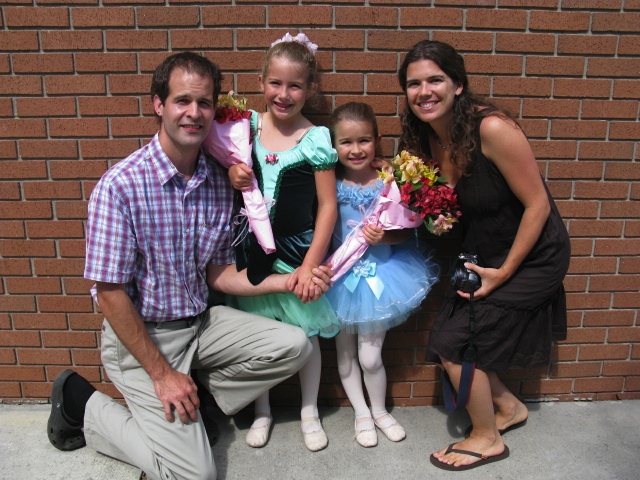
I went to Columbia last Sunday for Ellen's and Arianna's ballet recital. Ellen was in two numbers and Arianna in one, and they both danced flawlessly. Nicely done, girls!

IMG_1524

IMG_1526

IMG_1528

IMG_1533

IMG_1537

Thursday, May 28, 2009

Yard Food

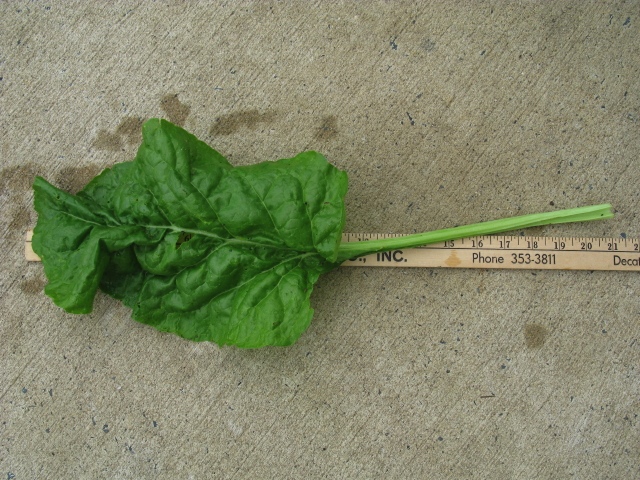
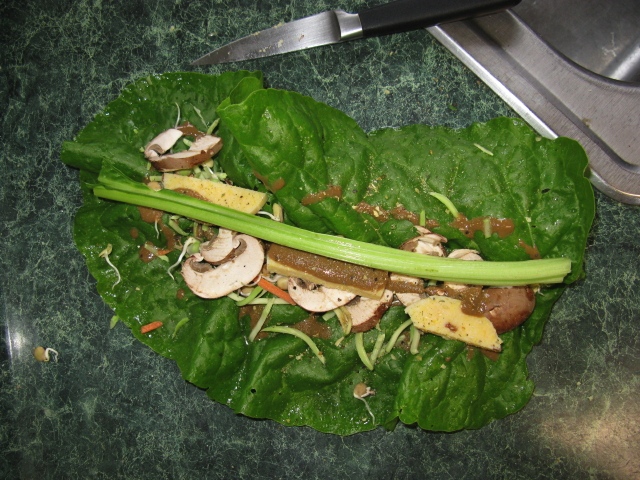
A small morning pleasure -- found this nice chard leaf . . .

IMG_1479

. . . in the chard "forest" this morning . . .

IMG_1483

. . . bent over from the night's rain. So I clipped it, took it in, added some shredded broccoli and carrots, lentil sprouts, a sliced mushroom, chunks of polenta, some (oil-free) mustard-base dressing, laid the stalk (crunchy like celery) down the middle (should have clipped some of Priscilla's spinach leaves to add, but forgot), and finished it with some garlic and herbs. Rolled it up burrito/wrap style and ate it for breakfast. Admittedly, not all those ingredients came from my yard or kitchen (sprouts), but they could have. So nice to eat out of the yard:

IMG_1513

Wednesday, May 27, 2009

Brussels Sprouts Sprouting

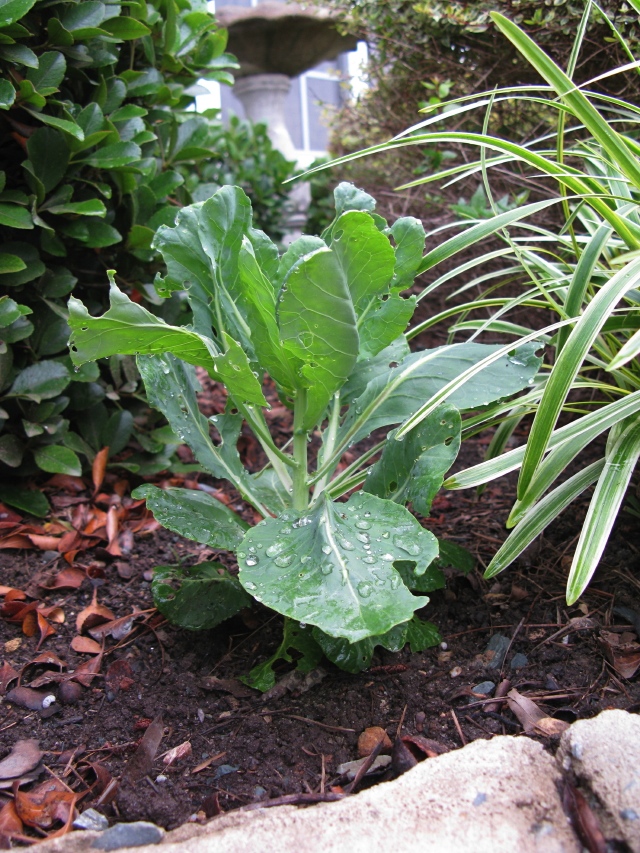
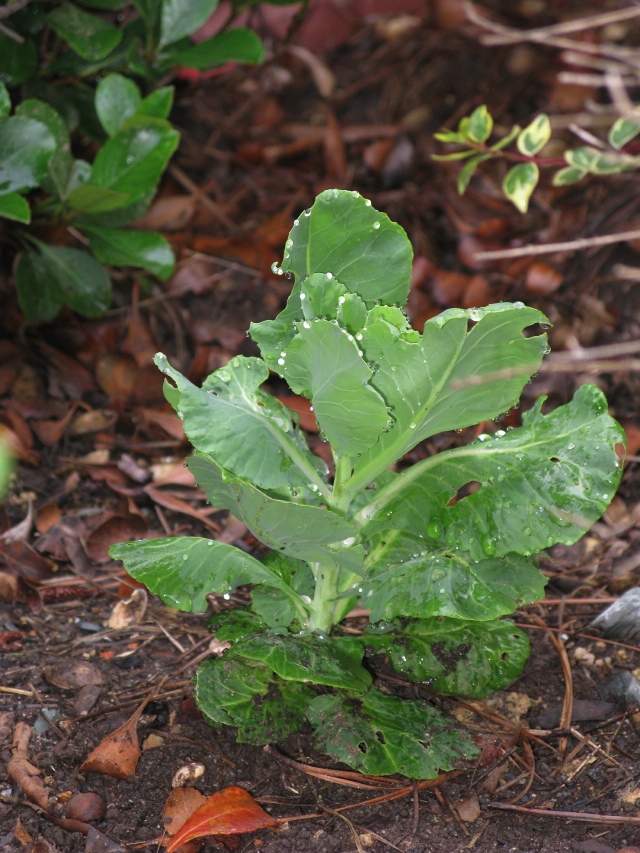
There's always something new to learn in a garden. A couple of Brussels sprouts that were buried in my garden soil along with my other vegetable scraps found their way near the surface of the soil — and took root and sprouted. I've had other veggie scraps do this (onions, garlic, tomatoes, etc.) but these are the first Brussels sprouts to do so. They appear to be growing into full-on Brussels sprouts plants. Only time will tell if they mature and bear sprouts of their own. I wonder if individual sprouts can be broken off the main trunk (I have bought the intact trunks filled with sprouts at EarthFare rather than buying loose sprouts) and rooted in transplant medium, getting a head start on creating seedlings for planting?

I'll update this post with progress shots to see what happens. But for now, they are looking like real-live Brussels sprouts plants:

IMG_1468

IMG_1469

Tuesday, May 26, 2009

CSA Bounty Keeps Getting Better

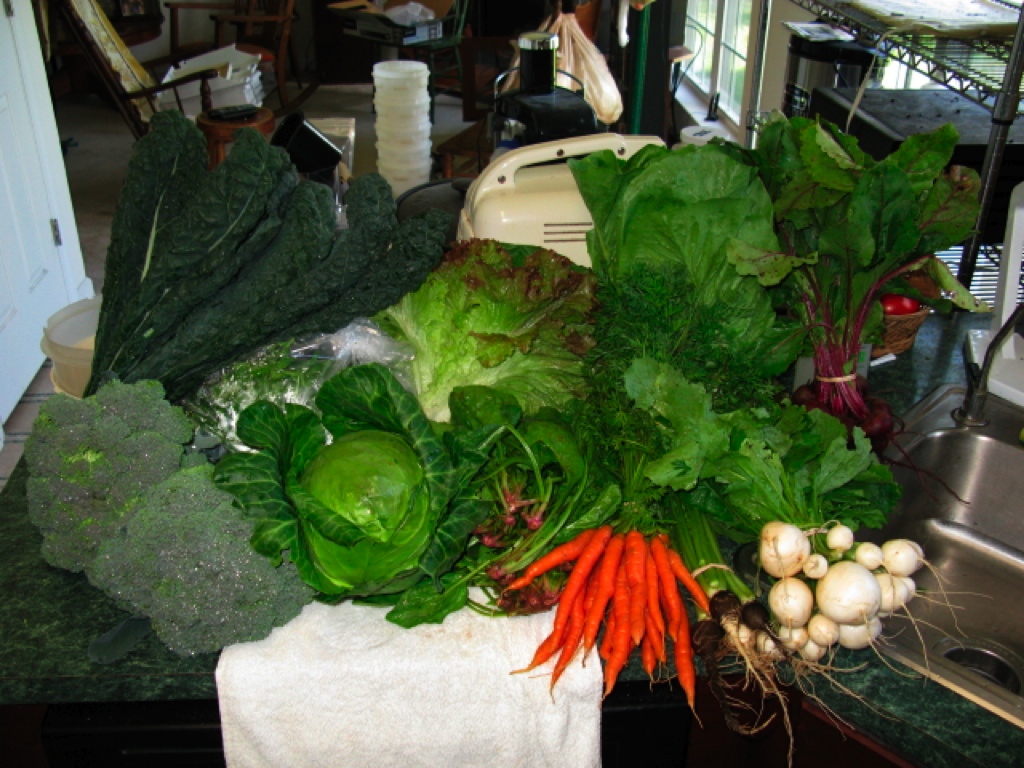
The CSA return just gets more bountiful every week—and this is still May! In today's box (L. to R.): two HUGE heads of broccoli, beautiful (18" tall) lacinato/dinosaur kale, bag of braising greens, head of cabbage, bag of spinach, HUGE head of red leaf lettuce, bunch of carrots, bunch of white and black radishes, another head of the BIGGEST-ROMAINE-I'VE-EVER-SEEN lettuce, and a large bunch of red beets. All picked fresh at New Town Farms this morning. Thanks for your hard work, Sammy!

I'll be fixing salads tonight for the guys in our small group -- this is way more than I can eat by myself in a week. (Each share of the CSA is for a family of four, thus the quantity. So stop by for a salad or "green meal!")

IMG_1467

Saturday, May 23, 2009

Farm Tour

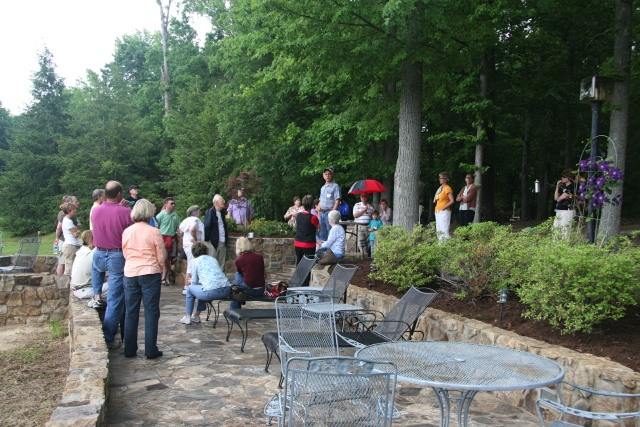
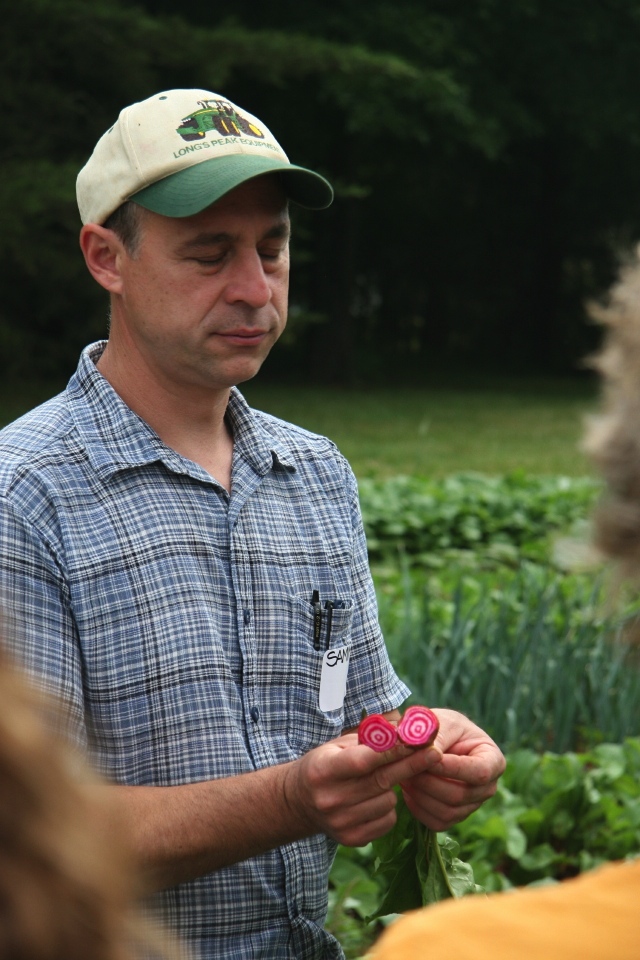
Went to a Farm Tour this afternoon at (certified organic) New Town Farms in Waxhaw, NC -- the farm in whose CSA program I participate. Here are a few pics from the tour:

Sammy (standing on steps, facing toward camera) welcoming the group:

IMG_1602

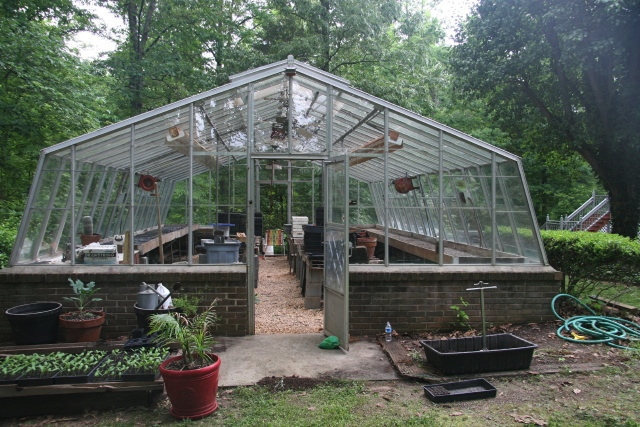
Sammy's glass greenhouse used for plant starts each spring:

IMG_1606

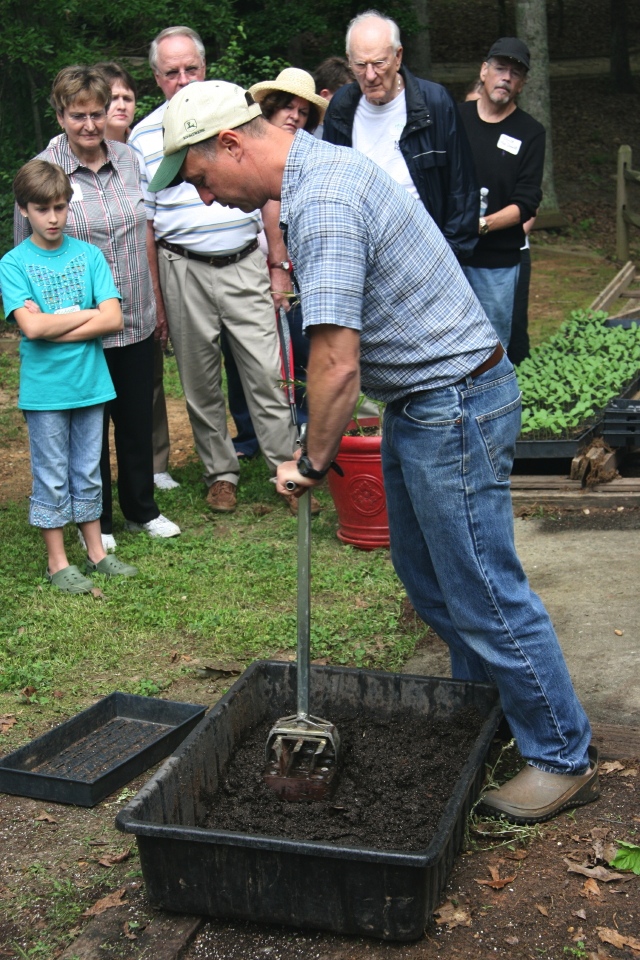
Sammy demonstrating the soil blocker used to make soil squares for starting seeds:

IMG_1605

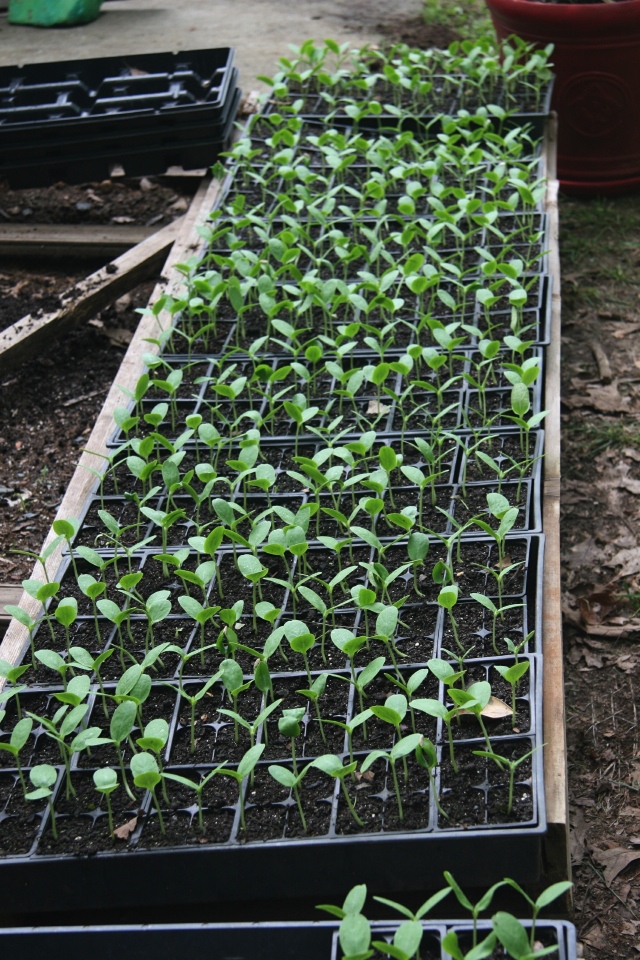
Melon starts hardening off before being transplanted:

IMG_1607

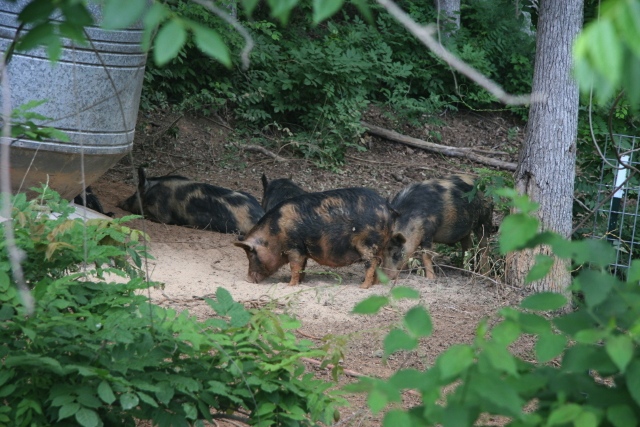
Small pig herd, a heritage breed descended from Spanish pigs left on the Georgia coast by Spanish explorers. Sammy's came from Mt. Vernon, descended from a herd owned by George Washington:

IMG_1610

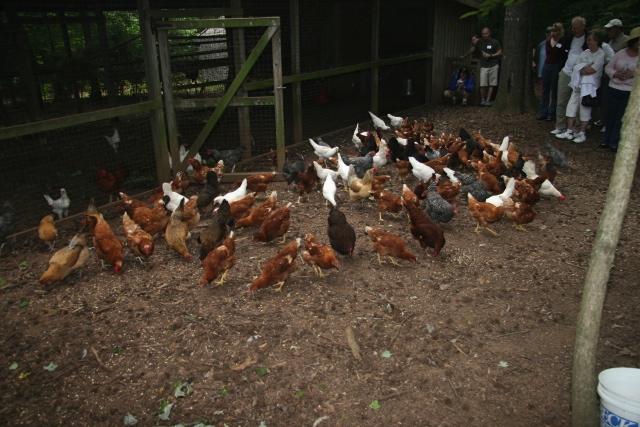
Most of the laying flock, about five different breeds producing different kinds of eggs:

IMG_1613

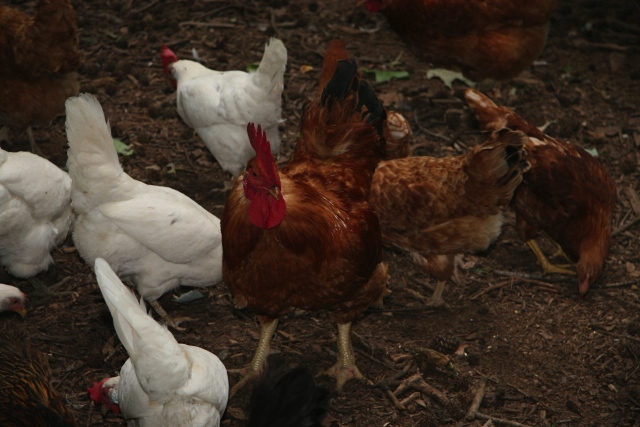
One rooster rules the roost:

IMG_1616

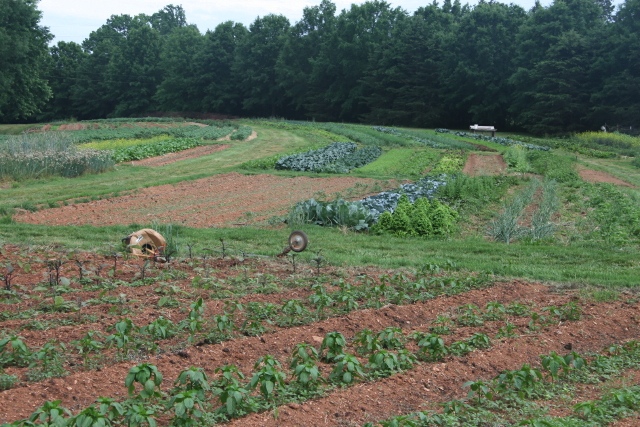
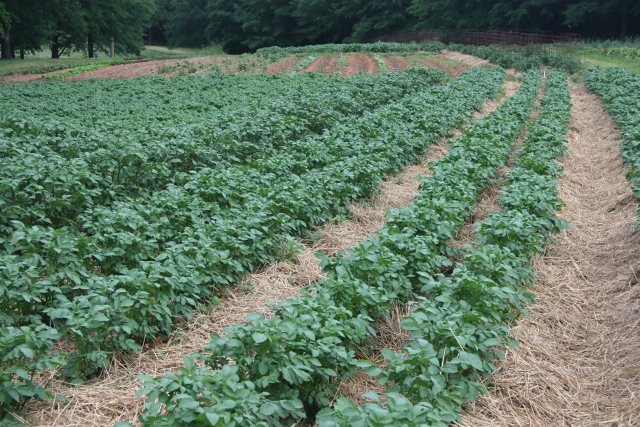
The fields -- between four and five acres under cultivation:

IMG_1624

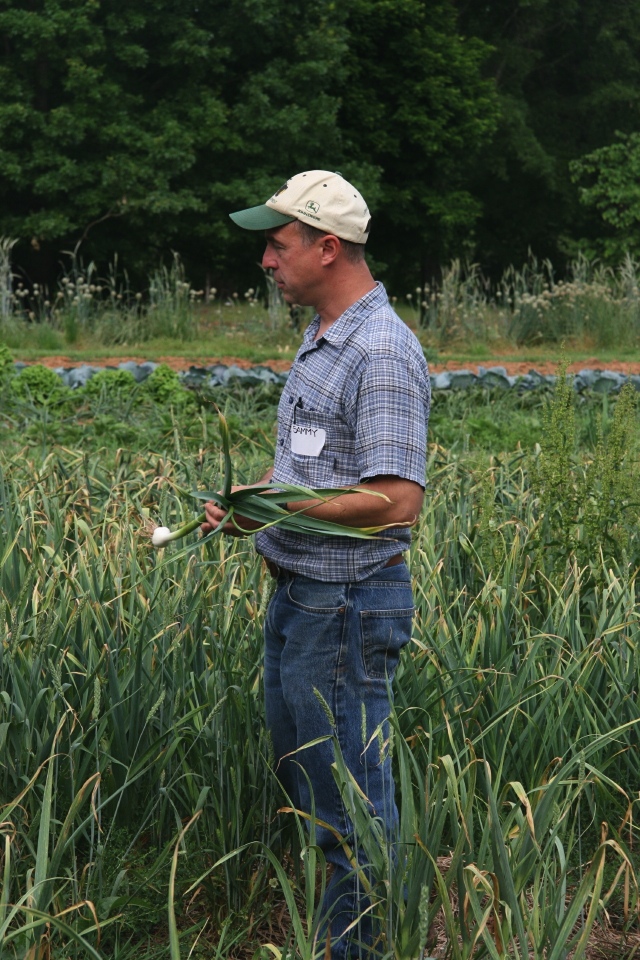
Nearly waist-deep in garlic:

IMG_1626

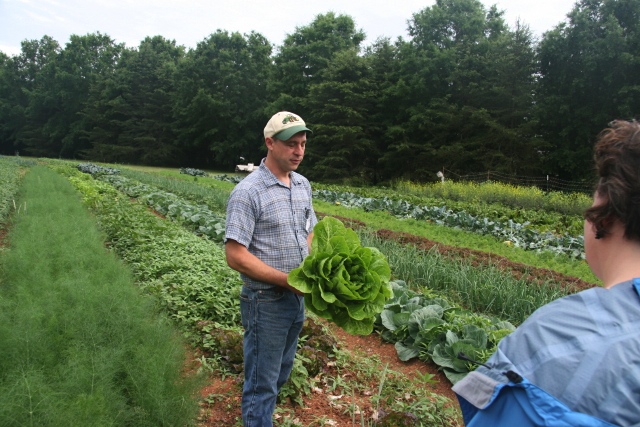
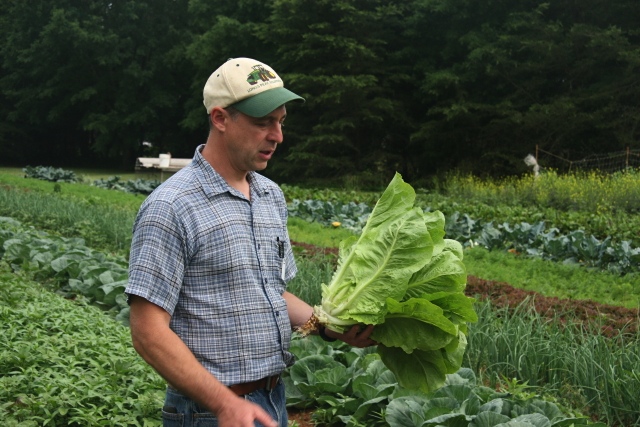
HUGE heads of Romaine lettuce:

IMG_1634

IMG_1635

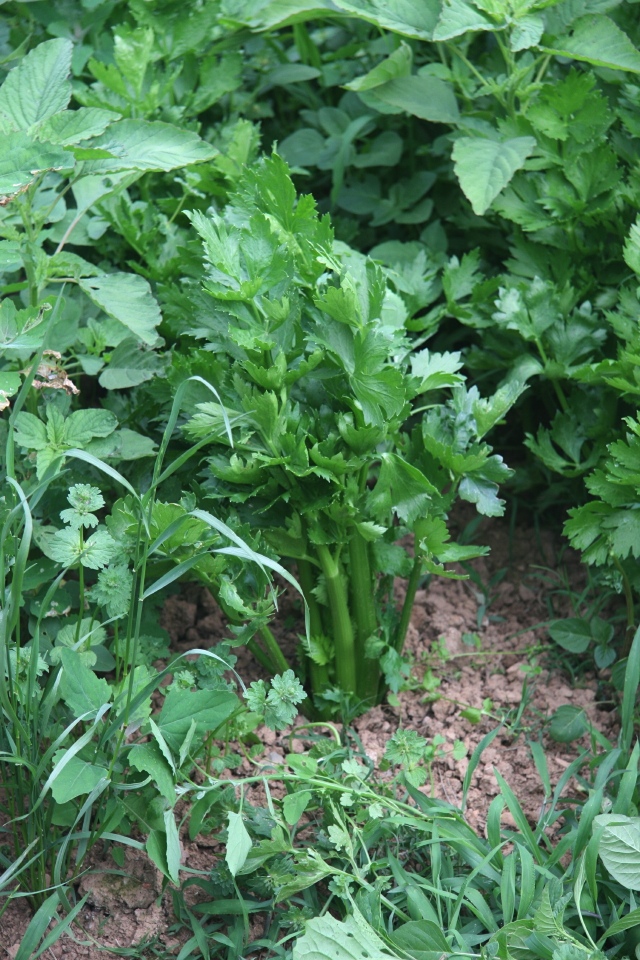
Celery coming up:

IMG_1628

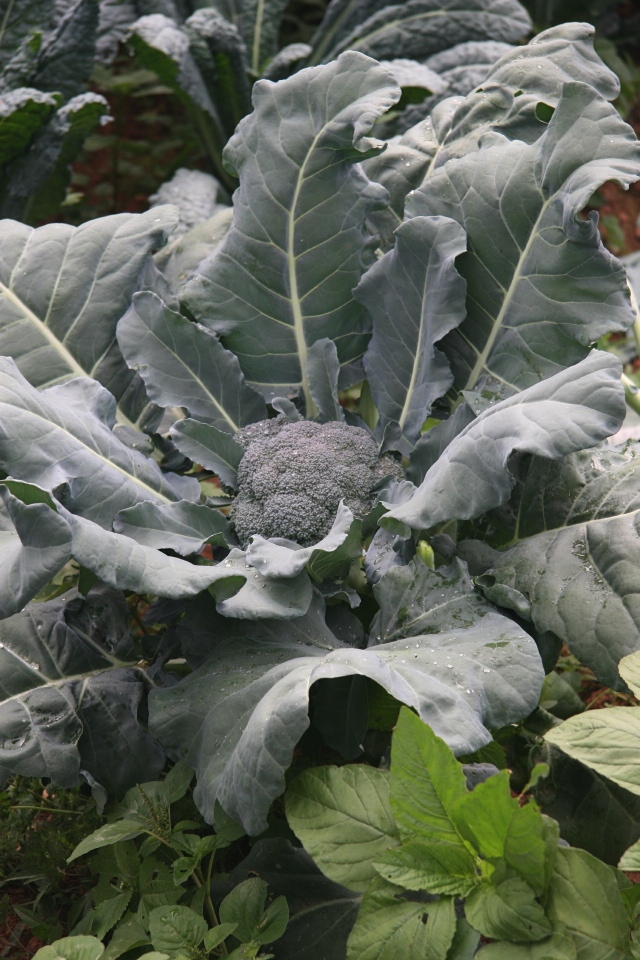
Broccoli crowning:

IMG_1629

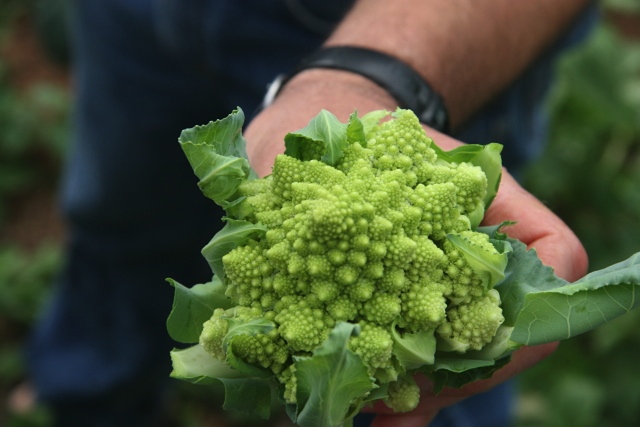
A funky Italian broccoli:

IMG_1632

And some Italian beets:

IMG_1637

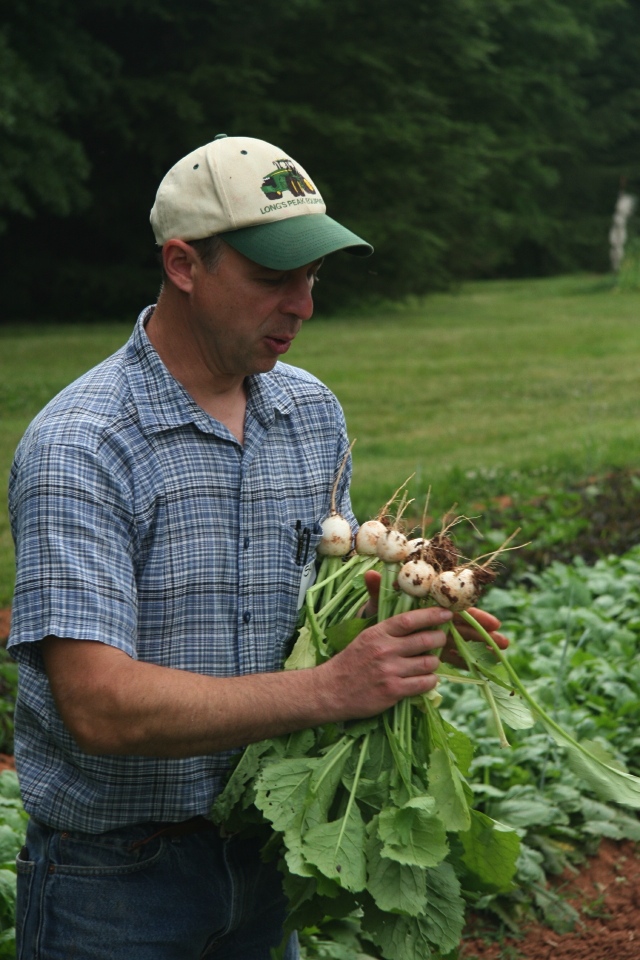
White, sweet turnips and greens:

IMG_1638

Ten different varieties of fingerling potatoes:

IMG_1636

Courtyard of Sammy's late father's home, now The Inn at New Town Farms:

IMG_1640

IMG_1641

An amazing farm operation, the result of 20 years of learning and hard work. Sammy's foodstuffs are sold at the Matthews Farmers Market, a 40+ member CSA program, and 10 Charlotte-area restaurants.

Tuesday, May 19, 2009

CSA This Week

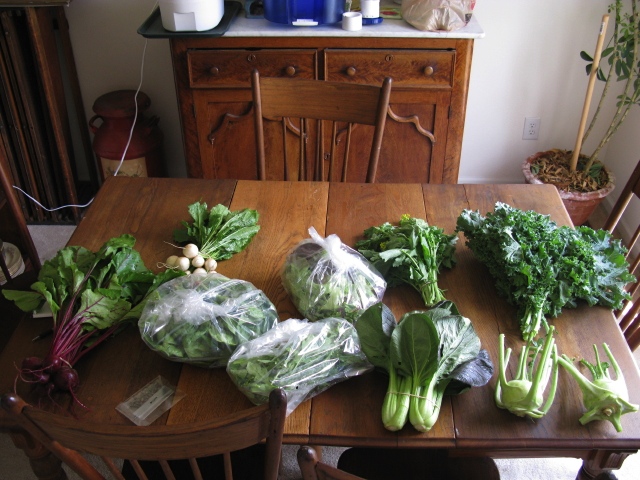
What a pleasure to receive my weekly box from the New Town Farms CSA! This week's offerings are baby carrots, turnips and greens, broccoli (barely visible on left edge of pic), rainbow chard, two kinds of beets w/ greens, two heads of baby bok choy, kohlrabi, mixed mustard greens, and two heads of lettuce (the largest head of Romaine I've ever seen in my life). Thanks, Sammy!

IMG_1462

Monday, May 18, 2009

Kruidenier Coat-of-Arms

Crest cropped

My neighbor, John, prepared a .jpg image for me of the Kruidenier coat-of-arms that I received from my father. (Thanks, John!) After posting it to the Kruidenier Family Group on Facebook, Sebes Kruidenier (Netherlands) wrote the following:

William - this is indeed the coat of arms of the Kruidenier family.

From a footnote from the "official" Kruidenier geneaology book:

"This is a 19th century wax print from a collection, that the Mayor of West- and East-Souburg (named Kruidenier) started using in 1941 as coat of arms for the Kruidenier family."

So unfortunately not an ancient registry, but claimed in Worldwar II.

Cheers. Sebes.

Saturday, May 16, 2009

WolframAlpha

I was blown away by the new WolframAlpha search engine. It's totally different from any other -- it is taking all the world's knowledge and putting it in retrievable form in formats that have to be seen to be believed. Go to the home page and click on "Watch Overview Video" in the right-hand column -- and don't let your jaw hit the floor. Anyone who does research on ANY TOPIC will make this a go to engine.

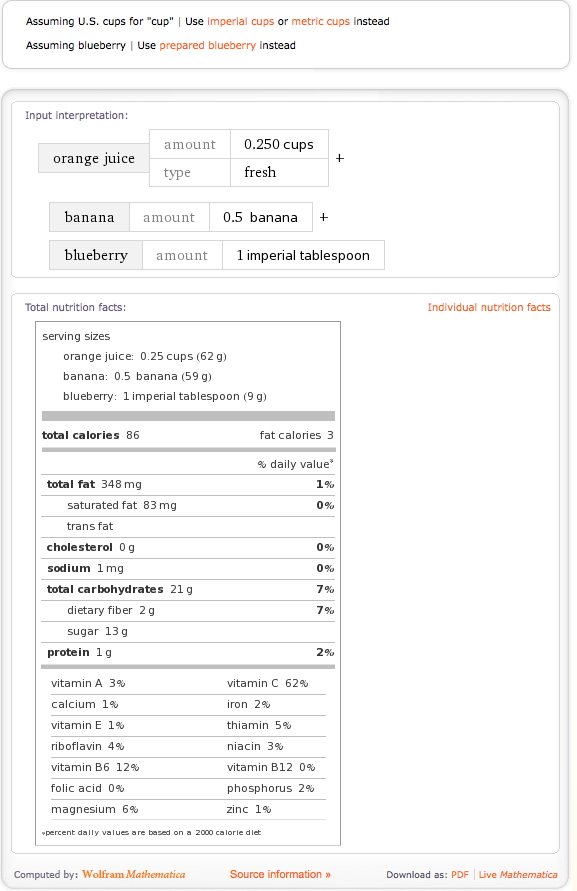
For instance -- I've always wanted to know the complete nutritional breakdown of the smoothie I make for lunch most days. When I tried entering all the things I put in the smoothie (about a dozen) I exceeded the limit of the engine. So I just put three to try it out: 1/4 cup fresh orange juice, half a banana, and 1 tbsp. blueberries. Here's what it returned -- pretty amazing: (I only wish it would let me enter all the elements.)
smoothie

Thursday, May 14, 2009

Lizzie Originals

Lizzie in Chicago has begun exercising her inner artist -- I love these paintings (acrylics on canvas). They are roughly 2' x 3' in size. My advice? Buy now before the word gets out and they skyrocket in price. :-) It's no wonder that her company has her go around to the other Chicago-area stores to help with "dressing" the inside of the stores. Good eye!

Flowers (the upper right corner has a piece of ceiling light shade that crept into the picture):

LizPhotoFlower1

Lizphoto2

Lizphoto1

Just got this picture today -- beautiful!

Lizphoto4

Keep it up, Lizzie!

Tuesday, May 12, 2009

You Know It's Spring When . . .

When I got home from picking up my CSA box today . . . (see what was in it below -- gets more full every week)

IMG_1461

. . . I noticed a pair of White Cabbage Butterflies bouncing around some transplants sitting by the front bed. That's when you know spring has arrived. They pupate over the winter and hatch into butterflies in the spring when they mate. The female goes about looking for members of the mustard family of plants (Cruciferae or Brassicaceae) on which to lay her eggs (which hatch into bad news caterpillars that devour these plants -- especially broccoli and cabbage). I didn't get a clear picture of the butterfly, but you can see the tiny egg she laid on a kale leaf (kale is part of the mustard family) -- the tiny white dot at the bottom edge of the leaf. Needless to say, the egg is no longer there:

IMG_1458

Sunday, May 10, 2009

Prayers for Priscilla

My friend, Priscilla, lives in Santa Barbara, CA, in the heart of the Jesusita Fire that has raged this past week. Unfortunately, the fire has touched her personally as it has many others. She sent the following pix that were posted on a local news website identifying the properties/addresses in some of the hardest-hit areas.

The first picture shows the firemen attempting to quench the flames that were attacking her house (she rents a portion of a home from a friend). Here's her description: Barely visible on the right is a fireman setting up a ladder to reach the corner of her house that had just started to burn. The side of the house was "scorched" and the eaves were beginning to burn; the glass in the windows on that side had shattered from the heat. A wooden storage structure in the back, along with a good portion of her (antique) shop inventory, was burned. She thinks the burning storage facility is what attracted the firemen to the house. I haven't received a follow-up from her, but my understanding is that the house, while badly damaged, was not destroyed.

The second picture is of the house across the street from Priscilla's, apparently fully engulfed and destroyed.


Priscilla's faith will keep her close to God as she works through this. But for all who pray, please ask God for wisdom and patience for her as she assesses the damage and figures out how to move forward. Fortunately, she has family and lots of friends from church and her business in the area. But, as it would be for any of us, these kinds of disruptions are a major body-blow -- but always result in unexpected opportunities to make course corrections, which we all need at times.

The promise that God causes all things to work together for good for those who love God and are called according to His purpose (Rom. 8:28) becomes real at times like this.

P.S. Update late Sunday from Priscilla -- the house was spared. A lot of scorched exterior wood, broken windows, burned fence, and the loss of the storage building and contents -- but the house is still standing. Thank you, Lord. Still, they're without power and lots of cleanup and repairs are looming -- your prayers of thanksgiving and for guidance are still appreciated.

Saturday, May 9, 2009

The "Otherness" of Animals


I just finished reading Dogs Never Lie About Love by Jeffrey Moussaieff Masson, a writer whom I have only recently learned about. I heard an interview with him on NPR recently about his latest book—The Face on Your Plate—and discovered among his dozen or more books are several on animals. A vegetarian and "near-vegan" (his words), and a PhD Sanskrit scholar, he brings wide-ranging research to his writing. I've acquired four of his books on animals and they are all heavily footnoted, yet very easily read.

In Dogs Never Lie About Love I read a passage that struck me as very helpful—about the "otherness" of dogs; that the world they inhabit is different from our own, and how often we overlook the deep sensibility and sensitivity by which they operate in their own world. The context of this quote is as follows: the emotional way in which his German Shepherd dog, Sasha, (one of his three dogs) relates to his two cats:
"Whatever [Sasha's] behavior means, it is clear that [she] is filled with feeling for these little kittens. It is clear because she moans and groans and follows them from room to room, and cocks her head and looks puzzled and intrigued. That is why I say she is possessed. She wants something from them, she feels something for them, and she seems to want to express those feelings.

"It is hard to empathize with her because humans generally do not walk behind kittens sighing and groaning. There does not seem to be an equivalent for us. Perhaps, then, Sasha is demonstrating to me one of my 'pet theories:' As well as the emotions animals and humans have in common, animals can also access emotions that humans do not share, one different from those we know, because animals are other; they are not the same as human beings. Their senses, their experiences, open them to a totally different (or new) set of feelings of which we know little or nothing. That a whole world of canine feelings remains closed to us is an intriguing notion. Some of these feelings could be based on the dog's sensory capacities. According to one early authority, a dog can smell 100 million times better than we do (I will return to the topic in Chapter 5). But even if the true figure is significantly less, the fact remains that when Sasha puts her nose to the ground, she becomes aware of a world about which I can only make guesses. Similarly, when Sasha cocks her ears, she hears sounds of which I am altogether unaware." (p. 6)
Masson is self-described as "not religious," so writes purely from an evolutionary perspective. But the above perspective holds interest for me as a Christian for how it addresses the issue of the animal kingdom created by God. I have thought (and stated in various stumbling ways) that Christians don't have a workable "theology of animals"—a way to describe what animals are "for;" why God created them. We enjoy the domesticated ones, eat the mass-produced ones, fear the aggressive ones, and are clueless about what to think about the rest. It is their "otherness" that confuses us. They are not like us, yet we haven't recognized that the sensory and feeling world in which they live is just as valid as ours in its own way. God understood their "way" since He ordained it, but we have not given them credit for having a way that goes much beyond responses of petting, eating, and fearing them.

I don't know what the answers are, but am interested in finding them for many reasons—not the least of which is supporting the (biblical, I believe) idea that animals were created for a higher purpose than being eaten or mistreated by humans. And I found Masson's simple description of the interaction between his dog and cats as illustrative in a helpful way of how much more we have to learn about the "other" animals. I think most sensitive Christians would agree with all this if they were asked to think about it. Most curious to me is that, among evangelical, Bible-believing Christians, it is for the most part not even on the agenda—so they continue to do what they've always done: pet, eat, fear, and cock their own heads at the curiosity of the animal kingdom.

Organic Teabag Fertilizer

The 2009-2010 catalog from Oikos Tree Crops arrived this week, and it is a pleasure to read. I learned about a product I've never seen elsewhere which makes great sense: organic fertilizer "teabags" to be dropped into a planting hole providing slow-release fertilizers to a new seedling. They sell them for tree starts, but my immediate thought was using them in the bottom of tomato and other transplants. They are rated at 7-7-2 with trace elements Ca, S, Mg, Zn, and Fe (Calcium, Selenium, Magnesium, Zinc, and Iron). Read more about them here.