I came across this word while perusing the pages of Old Southern Apples: A Comprehensive History and Description of Varieties for Collectors, Growers, and Fruit Enthusiasts (rev. and expanded edition). This second edition of apple hero Creighton Lee Calhoun, Jr.'s classic book has become a go-to source for information on historic, heirloom Southern apples. (Calhoun is a legend in the Raleigh-Durham area of North Carolina where he makes his home.)
While the book is a treasure itself, it pointed me to another treasure that resides deep in the belly of the USDA beast in Washington, D.C. -- the National Agricultural Library (NAL). This library is a huge repository -- way too much to explain briefly -- of American agricultural history. Lee Calhoun mentions the NAL because of the efforts that began in the late 19th century to identify and catalog thousands of varieties of American fruit. Here's a quote from Calhoun's book:
The United States Department of Agriculture (USDA) established a Division of Pomology in 1886 to collect and disseminate information to fruit growers. Almost instantly it was overwhelmed with boxes of fruit from the public with cover letters asking "what kind of apple (or pear or peach or cherry) is this?" By 1888, the Division of Pomology had received over 10,000 fruit specimens for identification!Accurate depiction of American fruit became necessary to aid in the task of identification. With color photography a distant invention, the division hired a series of accomplished watercolor artists, beginning in 1887, to paint pictures of American fruit. But the time this effort ended around 1940, over 7,700 paintings had been made of fruits and nuts. Some of these paintings were reproduced in USDA publications such as the annual Yearbook of Agriculture, but most were filed away and faded from public view. . . .The recent burgeoning interest in heirloom fruits has renewed the public's desire to see the pomological watercolors. A monetary grant from a private source in 2009 allowed the USDA's National Agricultural Library in Beltsville, Maryland to convert the watercolors to digital format and make the files available to the public.
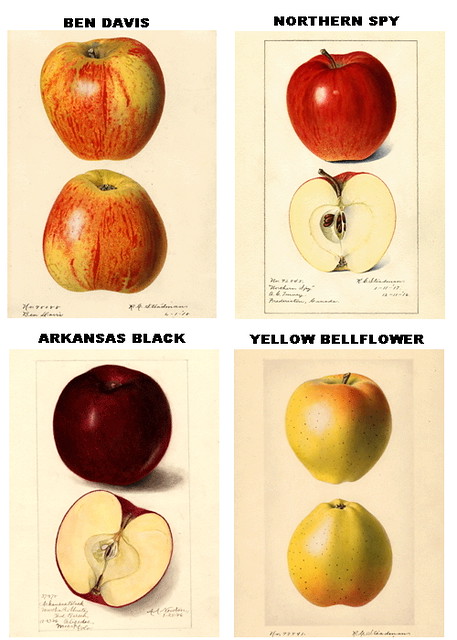
In Calhoun's book is a section of gorgeous color plates of 120 selected heirloom apple paintings from the NAL collection. Each painting contains, in the lower left and right-hand corners, in handwritten script, the artist's name, the date, the apple variety, the apple's location, etc.
This amazing art was created not just for apples, but for a variety of American fruits. Making my way to the NAL website I found a treasure trove of these digitized original paintings of apples and other fruits. And some prints have been nicely reproduced on 8" x 10" matte stock, suitable for framing and available for purchase.
Here, for instance, are the four apple prints currently available for sale via the NAL web site. (I borrowed these images from the NAL site without permission.):
The NAL web site is VERY large and not a little complex. But there is so much to see that it is worth the effort. Here are some links:
•The NAL home page is here.
•The NAL collections page is here. (Overview of the archives including the pomological watercolor collection.)
•Overview of Items currently available for purchase is here, including the four apple prints above which are the only apple/fruit prints kept in inventory for sale. Any of the pomological prints can be purchased, but the ones not kept in inventory are more expensive as they require one-off printing.
•The pomological watercolor collection is here. (Scroll down to link to watercolors of various fruits.)
•The apple watercolors begin here.
When I spoke with a nice woman at the NAL she said their goal was to get all the scanned watercolors printed and into inventory for purchase at the lower price. Right now, the only four apples available for purchase as 8" x 10" color prints ($25 each) are the four above. On the Collections page you can see a number of other products they have for sale in the spirit of agricultural history: note cards, posters, etc.
For North Carolina apple growers, one of the best sources of heirloom apples suitable for our climate is Ron and Suzanne Joyner's Big Horse Creek Farm ("specializing in antique and heirloom apple trees") in Lansing (Ashe County), NC.
I am gradually coming to understand more about antique apple varieties. Estimates range from 5,000 - 7,000 for the number of apple varieties once available in America. Today, consumers find the same 6-8 varieties in their grocery store. Thus, the effort being made by many to find and preserve "antique" apple varieties.
I've never understood the "Johnny Appleseed" idea of spreading apple seeds all around the NE United States in the early 19th century, resulting in the aggressive spread of apple trees -- when all apple trees today are grown by root stocks, not seed. Here's what happened as I understand it: Apple seeds can be sprouted and trees grown, but the vast majority of the time the resulting apple will be undesirable in one or more ways. "Pippin" apples, those sprouted from fallen apples that sprout their seeds and produce a new apple, are usually not keepers and are not reproduced. (Many of these were used to produce alcoholic hard cider more than a hundred years ago.) When a "pippin" apple tree arose and was found by chance to produce a desirable fruit, its branches (a scion) would be grafted onto an existing root stock and a tree grown to reproduce the desirable fruit.
So -- apple seeds will produce apple trees and apples, but these random efforts only occasionally produce "keepers" -- which are then reproduced via grafting to preserve the variety. (Please correct me if this is not accurate.)
I am more than willing to criticize our government for spending money we don't have, and for collecting taxes to pay for things that federal governments should leave to citizens and free enterprise. But I now find myself conflicted. The NAL archives are a store of history and pleasure for people like me, and while the digitizing of the fruit paintings was funded by a private donation, the library itself is obviously federally funded. If push comes to shove -- and it has definitely come to that with our bankrupt government -- I would have to conclude that things like the NAL would have to go if we can't pay for it. But for the moment, I'm glad it's there.
This short video is about Tom Brown, an antique apple hunter in the Blue Ridge Mountains of NC/VA:






 Posts
Posts


