Thursday, October 27, 2011

Spearfishing in Heaven?

I recently enjoyed reading John Eldredge's latest book, Beautiful Outlaw—Experiencing the Playful, Disruptive, Extravagant Personality of Jesus.

Those who have read Eldredge's previous books—especially Wild at Heart—know his perspective on spirituality to be muscular, aggressive, and humanistic in a good way—using Jesus' perfect humanity as a template for Christian spirituality, especially for men. For Eldredge, Jesus seems to be Sir Lancelot, William Wallace (Braveheart), and Tristan Ludlow (Legends of the Fall) rolled into one.

Eldredge has done us a favor in his books by reminding us that Jesus was a man and helping to restore an image of what it meant to be the Second Adam. Beautiful Outlaw spotlights the extravagant, disruptive, scandalous, cunning (Eldredge's words) nature of Jesus, along with His more familiar virtues of humility, honest, and beauty. So far, so good—until the end of the book.

In the last four pages of the book, Eldredge recounts an interview in which he was asked a question for which he wasn't prepared:

"What are you looking forward to with Jesus?"

He realized that, for all the thought he had put into his present experience with Jesus, he hadn't given a lot of thought to his future with Jesus. The question made him remember that a day is coming when he will see Jesus face-to-face and share life with Him.

For my part, when I read the interviewer's question, my first thought was, "Do you mean 'looking forward to' in the sense of the rest of my life here on earth?" or "Do you mean 'looking forward to' in the sense of the future as eternity?"

Eldredge obviously understood the question as referring to eternity, to heaven, because he cites the passage from Matthew 19:28-29 in which Jesus tells His disciples,

"In the re-creation of the world, when the Son of Man will
rule gloriously, you who have followed me will also rule,
starting with the twelve tribes of Israel."
(The Message)

He goes on to emphasize the "re-creation of the world," calling it "a renewed heavens, a renewed earth":
"My friends, I hope you understand that we get the entire glorious kingdom back. Sunlight on water, songbirds in a forest; desert sands under moonlight; vineyards just before harvest—Jesus fully intends to restore the glorious world he gave us. Paradise lost; paradise regained. A hundred times over." (pp. 217-218)
In his eloquent way, Eldredge paints a picture of Eden reborn, the anticipation of which is hard to deny. But typical of Eldredge, he tends to read back into Eden romantic aspects of our fallen world, both in human and non-human dimensions. For example, will there really be deserts—"desert sands under moonlight"—in the new earth? Aren't deserts a sign of environmental disruption, hardly typical of "paradise regained"?

Quibbles aside, I was with him as he built a case for the joy of knowing, and being known by, Jesus in the "re-creation of the world." Only after painting the picture of what raced through his mind as he pondered the interviewer's question does Eldredge give us his answer—what he is looking forward to with Jesus when the world is restored to its created glory:

"Spearfishing." (p. 218)

Spearfishing?

He explained:
"I know this beautiful world will be ours again and so will Jesus, and all the time imaginable to play together. Beauty. Intimacy. Adventure. The very things we were given at the dawn of time. But honestly, more than all that, I'm just looking forward to seeing him, looking into his eyes, hugging him as Peter did on the beach and not letting go for a very long time." (p. 218, italics added)
First, credit is due for his priority of simply seeing Jesus rather than playing together. But his dream of "spearfishing" with Jesus in heaven, reflective of "the very things we were given at the dawn of time," is hugely problematic, biblically speaking.

Before saying why, I'm going to cut Eldredge some slack. The man is a hiker, a hunter, a high-mountain man—think William Wallace in High Sierra instead of Highlands plaid and Tristan Ludlow in Merrills instead of moccasins. His meal of choice is fresh meat on the bone and trout in the pan—preferably killed and cleaned with his own hands. So, not surprisingly, his idea of how to spend a day with Jesus in heaven is "spearfishing."

And that's where Eldredge gets into trouble biblically—reading the proclivities of fallen human beings back into an unfallen Eden ("the dawn of time") or forward into a recreated new earth ("the restored glorious world").

Where, in Genesis, does one find the image or idea of Adam spearing a fish, leaving a trail of blood in the water, for his food? God's prescribed diet for humankind was plants (Genesis 1:29). Yes, after the fall of humanity into sin and Eden into disrepair, a concession was made to allow man to consume animals for food (Genesis 9:1-6). But such a practice was not present at "the dawn of time."

And from where does the idea of Jesus being an enthusiast of killing animals for sport come? Jesus entered human history thousands of years past "the dawn of time" when concessionary practices were well established, such as raising animals for their by-products and pulling nets of fish from the sea. In fact, He facilitated such cultural practices by advising His disciples where to cast their nets to find a bountiful catch. He even ate a piece of fish Himself as a demonstration of His physical resurrection (and perhaps ate flesh foods on other occasions as well).

Jesus chose not to try to restore Eden in three years of ministry. Rather, He introduced the present-and-future kingdom of God in which all things (as Eldredge rightly notes) will be ultimately restored, ultimately recreated. But even though Jesus lived in the concessionary parenthesis in which we ourselves live, we don't see Him in Scripture as the blood-and-bone adventurer that Eldredge and those in the "Christian sportsman" movement want Him to be—taking pleasure in spilling the blood of animals for sport or even for food when such killing for food is neither original (Genesis 1:29) or necessary (as in today's world where plant foods are abundant).

How does the idea of "spearfishing with Jesus" fit with Isaiah's image of the future recreation?

The wolf will live with the lamb,
the leopard will lied down with the goat,
the calf and the lion and the yearling together;
and a little child will lead them.
The cow will feed with the bear,
their young will lie down together,
and the lion will eat straw like the ox.
The infant will play near the hole of the cobra,
and the young child put his hand into the viper's nest.
They will neither harm nor destroy
on all my holy mountain,
for the earth will be full of the knowledge of the Lord
as the waters cover the sea.
(Isaiah 11:6-9)

That sounds like an Edenic setting, something to be found at the "dawn of time." And Isaiah says it will happen in the future—at least until John Eldredge and Jesus show up with their spears, bows and arrows, and guns and knives and start recreating the fall all over again on the new earth, staining soil and water with the blood of animals who were created to trust man, not fear him (Genesis 2:19-20).

Really? Something tells me Jesus won't be part of that adventure, nor will He sanction Eldredge or any other citizen of the New Jerusalem marring the eternal kingdom with behavior that is characteristic of fallen humanity.

Here's where I'll cut Eldredge a second portion of slack. What if he used "spearfishing" as a metaphor for "guys hanging out doing what guys do"? What if he used "spearfishing" as a way to say "spending time around the campfire with Jesus and a PBR, talking about life in guy terms"?

If that's what Eldredge meant, that's what he should have said. In Beautiful Outlaw and his previous books, he has established himself as a man's man who likes to hunt and fish and live in the great outdoors. So when he says he looks forward to spearfishing with Jesus in heaven, one can only assume he means shooting a barbed arrow through a defenseless fish, mortally wounding it, spilling its blood in the ocean simply because it's possible to do so.

In either case—whether Eldredge is speaking literally or metaphorically about spearfishing—it's an example of mature, thinking Christians not having a biblical theology of animals. Whether one uses hunting as a metaphor for "fun and fellowship" or a reference to a literal act, in neither case is there biblical grounds for doing so. The Bible gives no indication that animals were treated with anything less than complete respect at "the dawn of time" or will be in the restoration of all things. The fact that we treat them otherwise during the concessionary parenthesis of this age is a sign of our fallenness, not our maturity. (What Christian could be called mature who uses the concession of divorce as a way to casually and without cause dishonor the Edenic, permanent institution of marriage? The same question applies to animals. Concession does not equal creed; permission does not equal prescription.)

If you want a thought-provoking, biblically-based book on the humanity of Jesus (that doesn't diminish His divinity at the same time), read Beautiful Outlaw. Just don't make the mistake Eldredge makes of reading into your present or future life with Jesus everything that fallen man has invented for pleasure or entertainment—like the killing of animals.

God is in the process of conforming us to the true image of Jesus (Romans 8:29). We only distort and delay the process when we imagine Jesus looking in a mirror and seeing us.

Wednesday, October 26, 2011

The Skill of Blaming Others

At a fundraiser in San Francisco yesterday, president Obama said,

"We have lost our ambition, our imagination, and our willingness to do the things that built the Golden Gate Bridge."

The arrogance of that statement is stunning. Imagine: in three short years—since he became president—America's people have lost their ambition, their imagination, and their willingness to dream and build big. None of it is his fault, of course. It's all our fault. For some reason, which he failed to reveal, America's entire ideological ethic has changed.

I wonder if he can't see the correlation: This so-called loss of ambition, imagination, and ability to build big has happened on his watch. (It goes without saying that there has been no loss of ambition, imagination, or ability. People are doing what is natural in the face of the unknown—consolidating in a defensive position until the enemy leaves the gates.)

More and more, the evidence is that this man is in way over his head. For his own sake (and ours), I hope his misery ends next November.

Tuesday, October 25, 2011

Welcome to Amerika 2

In my humble opinion (and that of lots of businessmen), the number one impediment to job creation and economic growth in America is the Obama administration—period—for at least three reasons: excessive regulations, the highest corporate tax rate in the world, and uncertainty about future costs connected to ObamaCare. Businesses can't grow, and won't grow, until something is done about all three.

I have followed the story of the Gibson Guitar Company for months now. Their factory was raided in 2009 (by armed federal SWAT teams) for suspicion of breaking laws relating to the importation of certain kinds of woods used in guitars—woods that are on endangered species lists in certain countries. Gibson maintains its innocence (they have never been charged with any violation) and the countries of Madagascar and India have said Gibson violated no export laws of their countries. Yet Gibson continues to be persecuted by the federal government. This is a great example of the kind of irrelevant and unnecessary interference by the government in business.

Here's a short interview with the president of Gibson summarizing the situation:

Thought for the Day 14.0

In the preface to his new book, Suicide of a Superpower—Will America Survive to 2025?, Pat Buchanan asks,

"What happened to the country we grew up in?"

The last paragraph of the Preface provides an eloquent summary of what has gone wrong:
"When the faith dies, the culture dies, the civilization dies, the people die. That is the progression. And as the faith that gave birth to the West is dying in the West, peoples of European descent from the steppes of Russia to the coast of California have begun to die out, as the Third World treks north to claim the estate. The last decade provided corroborating if not conclusive proof that we are in the Indian summer of our civilization. Historian Arnold Toynbee wrote, 'Civilizations die from suicide, not by murder.' And so it is. We are the Prodigal Sons who squandered their inheritance; but, unlike the Prodigal Son, we can't go home again."

Monday, October 24, 2011

Ron Paul: Still Making the Most Sense

Ron Paul is still making a lot of good sense. Here he is on last Sunday's Meet the Press:

Remembering with Excellence

It's not enough for Apple to create insanely great products (Jobs' term) -- they even do insanely great memorial services. The outdoor memorial service for Steve Jobs was great: reminiscences by Tim Cook, the new CEO, Bill Campbell, longtime board member, Johnny Ives, who designs the Apple products, and most compelling, Al Gore, Apple board member. For all of Gore's wacky politics, the man is a terrific speaker. Music by Nora Jones and Coldplay—wow! I got tears and chills listening to the Coldplay song that backed one of the early iPod commercials.

The whole service is a reminder that good and great are not enough in life—only insanely great will change the world.

You can watch the service here.

Saturday, October 22, 2011

Need for Speed

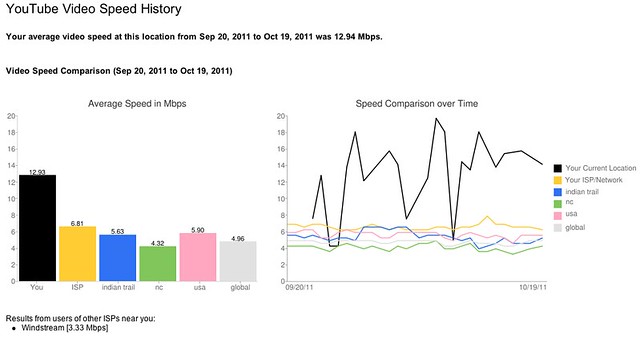
While watching a YouTube video, I accidentally control-clicked (Mac; right-click on PC) on the video window while it was playing and discovered a choice to view my download speed for YouTube videos for the last month compared to other local communities, my state, and the USA. As you can see from the chart below, I averaged about 13 megabytes per second download speed while watching YouTube videos—significantly higher than the other averages presented. I wonder how accurate these numbers are? With the proliferation of broad-band connections (I have Road Runner Turbo), I would think average download speeds would be higher than 4-5 megabytes per second. Knowing, however, how many homeowners use DSL to connect to the Internet, which is VERY slow compared to cable (see the "Windstream" rating in the lower-left corner—3.3 mpbs—which is a local telephone/DSL Internet provider in my area), perhaps the numbers are accurate. But my speed of 13 mbps from YouTube is still significantly less than what I get when testing my down-and-up-load speeds at sites like speakeasy.net and speedtest.net (depending on the time of day around 21-25 mbps). Understandably, downloading a video from YouTube might be slower than a clean packet download from a test site.

Watch a YouTube video and check your own download speed compared to other averages.


Screen shot 2011-10-20 at 4.52.07 PM

Monday, October 17, 2011

At least once a year . . .

At least once a year, I try to spend an hour at the web site of the Blue Rock Artist Ranch and Studio to watch videos of the acoustic artists and bands that have performed there. Blue Rock is located near Austin, Texas, and combines a high-end music production facility with a small, intimate concert venue. They keep a regular schedule of top indie and labeled acoustic artists coming through. Most are unknown to me, I'm sorry to say, but I thoroughly enjoy the professionally produced video summaries of their concerts. Well worth an hour or two of time.

Biblical Illiteracy

s_o25_15128106
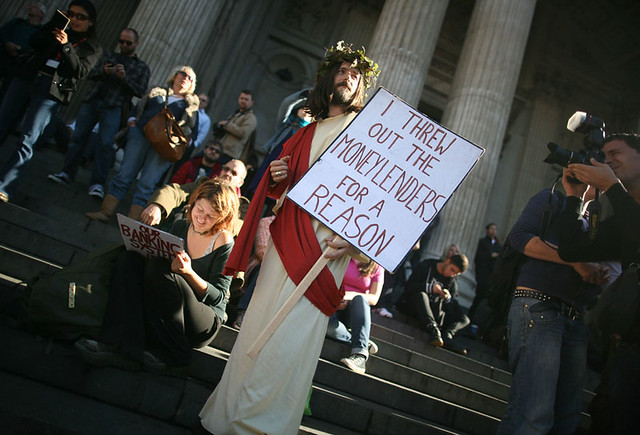
What's wrong with this picture? (If the Wall Street occupiers don't know any more about the economy than they do about the Bible, they're in for a disappointing run.)

Saturday, October 15, 2011

Touché, Warren!

As a much-more-fair counter to Obama's "Buffett Rule" (forcing the wealthy to pay higher taxes), a senator and representative have introduced legislation to provide the opportunity on tax returns for any citizen to donate $1.00 or more to reduce the federal deficit. Excellent! Now, Mr. Buffett, along with all the other self-titled "patriotic millionaires" can step up and voluntarily give their money to their bleeding hearts' content. I don't know if we'd ever be told, but my bet is that none would do it.

Alas, they'll likely not have the chance since the legislation has zero chance of passing the Democratic-controlled Senate.

Read the whole story here.

Amazing Design for Sustainable Food Production

Back to Eden is a new film on sustainable gardening techniques. Ironically, the techniques are not new, but mirror the way nature has reproduced bountifully for eons. The subject of the film, Paul Gautschi, mixes his knowledge of the Bible with his gardening techniques, which I found quite insightful. The first half of the film is narrated by him and exposes his own work and is excellent. The third quarter is about other families that have implemented his techniques, and drags a bit (but very practical in terms of how to turn a grassy plot into the kind of garden he has built up over years). But the last quarter of the film returns to Gautschi. What this guy has implemented is truly amazing. Anyone who has ever labored with dry soil and weeds will be bowled over.

The film is available for purchase and watching for free at the film's web site (scroll down). Well worth the investment of time.

Friday, October 14, 2011

Clapton and Cordings

For those who love tweed and tattersall—and who incline toward Eric Clapton—this video will have appeal. Cordings is a traditional maker of fine men's and women's clothing in the British tradition, located in London. Clapton tells the story of his lifelong love of English tradition, especially clothing—so much so that he is now a co-owner of Cordings.

I smiled all the way through this video at the thought of Eric Clapton, having survived drugs, Cream, the Sixties and Seventies, now settling into his graybeard years as a tailor—or at least a partner of tailors. And who can blame him? When you see the closeups of the tattersall shirts in this video, one's sartorial pulse is immediately quickened. And note the beautiful gussets built into each side of the back of the jacket he tries on, to allow plenty of motion for swing shooters in the field. Gotta' love the British style, if not the reasons (shooting birds). But that alone sets the British apart—the fact that they go bird shooting in tweed jackets, tattersall shirts, and wool ties.

Thursday, October 13, 2011

Indian Vegan Recipes


To get 21 days of vegan recipes from India, sign up for the Physician's Committee for Responsible Medicine's "21-Day Kickstart India" campaign. (Starts in November.)

Beautiful Bread

Chad Robertson has become world famous for the bread he bakes at his Tartine Bakery in (where else?) San Francisco:


His book about bread, Tartine Bread, is available for home bakers to learn his ways.

B-12, D, and Iodine

From solid vegan nutritionist Ginny Messina in an article on vitamin/mineral supplements:
But vegan diets always need to be supplemented with B12 on a regular basis (not “occasionally”) and often with vitamin D. If you don’t use iodized salt you should take a supplement of iodine. I recommend a DHA supplement as well, although the research on benefits remain conflicting.
My two cents: From what I've read, the population at large is mostly B-12 deficient which is problematic since B-12 is so critical to long-term health. No one should be adding extra iodized (regular table) salt to their food because of the negative effects of salt (hypertension, etc.). (Even sea salt should be limited.) Iodine is critical for thyroid health, but getting iodine from sea sources (kelp, dulse flakes, etc.) is far healthier than from iodized table salt. (The government mandated the addition of iodine to table salt years ago to make sure the population got iodine, a non-optional ingredient. Table salt is nothing but a delivery vehicle for the iodine which we do need. Gov: "What does every American crave to which we can iodine?" Answer: "Table salt.")

Lots of vegans STILL don't take B-12 regularly, to their detriment. Omnivores get B-12 from meat, vegans and vegetarians have to get it from other sources. Supplements are the safest, most predictable way. It's inexpensive and plentiful. (The methylcobalamin version of B-12 is supposedly better absorbed than cyanocobalamin -- look on the label for the kind. But either is better than none.)

n.b.—the presence of B-12 in meat is not an argument AGAINST plant-based diets. Animals get the bacteria that synthesizes to B-12 by eating plants in nature, and they process it well because of their extensive gut systems, getting into their flesh which humans consume. We would get the same bacteria from nature if we "grazed" plants like we were created to do (Genesis 1:29). Instead, we eat sterilized plant foods, miss the bacteria, and thus produce little B-12 of our own. (I've made this argument in this space many times before and make it again only to dispel the common myth that the presence of B-12 in meat is an argument against plant-based diets.)

(Thanks to vegan.com for the link.)

Monday, October 10, 2011

Thought for the Day 13.0

1. In my many years I have come to a conclusion that one useless man is a shame, two is a law firm and three or more is a congress.
-- John Adams
2. If you don't read the newspaper you are uninformed, if you do read the newspaper you are misinformed.
-- Mark Twain

3. Suppose you were an idiot. And suppose you were a member of Congress. But then I repeat myself.
-- Mark Twain

4. I contend that for a nation to try to tax itself into prosperity is like a man standing in a bucket and trying to lift himself up by the handle.
-- Winston Churchill

5. A government which robs Peter to pay Paul can always depend on the support of Paul.
-- George Bernard Shaw

6. A liberal is someone who feels a great debt to his fellow man, which debt he proposes to pay off with your money.
-- G. Gordon Liddy

7. Democracy must be something more than two wolves and a sheep voting on what to have for dinner.
-- James Bovard, Civil Libertarian (1994)

8. Foreign aid might be defined as a transfer of money from poor people in rich countries to rich people in poor countries.
-- Douglas Casey, Classmate of Bill Clinton at Georgetown University

9. Giving money and power to government is like giving whiskey and car keys to teenage boys.
-- P.J. O'Rourke, Civil Libertarian

10. Government is the great fiction, through which everybody endeavors to live at the expense of everybody else.
-- Frederic Bastiat, French economist(1801-1850)

11. Government's view of the economy could be summed up in a few short phrases: If it moves, tax it. If it keeps moving, regulate it. And if it stops moving, subsidize it.
-- Ronald Reagan (1986)

12. I don't make jokes. I just watch the government and report the facts.
-- Will Rogers

13. If you think health care is expensive now, wait until you see what it costs when it's free!
-- P.J. O'Rourke

14. In general, the art of government consists of taking as much money as possible from one party of the citizens to give to the other.
-- Voltaire (1764)

15. Just because you do not take an interest in politics doesn't mean politics won't take an interest in you!
-- Pericles (430 B.C.)

16. No man's life, liberty, or property is safe while the legislature is in session.
-- Mark Twain (1866)

17. Talk is cheap...except when Congress does it.
-- Anonymous

18. The government is like a baby's alimentary canal, with a happy appetite at one end and no responsibility at the other.
-- Ronald Reagan

19. The inherent vice of capitalism is the unequal sharing of the blessings. The inherent blessing of socialism is the equal sharing of misery.
-- Winston Churchill

20. The only difference between a tax man and a taxidermist is that the taxidermist leaves the skin.
-- Mark Twain

21. The ultimate result of shielding men from the effects of folly is to fill the world with fools.
-- Herbert Spencer, English Philosopher (1820-1903)

22. There is no distinctly Native American criminal class...save Congress.
-- Mark Twain

23. What this country needs are more unemployed politicians.
-- Edward Langley, Artist (1928-1995)

24. A government big enough to give you everything you want, is strong enough to take everything you have.
-- Thomas Jefferson

25. We hang the petty thieves and appoint the great ones to public office.
-- Aesop


Five Truths:

1. You cannot legislate the poor into prosperity, by legislating the wealth out of prosperity.

2. What one person receives without working for...another person must work for without receiving.

3. The government cannot give to anybody anything that the government does not first take from somebody else.

4. You cannot multiply wealth by dividing it.

5. When half of the people get the idea that they do not have to work, because the other half is going to take care of them, and when the other half gets the idea that it does no good to work, because somebody else is going to get what they work for, that is the beginning of the end of any nation!


(Thanks to Dan B.)

Friday, October 7, 2011

"When I was your age . . . ."

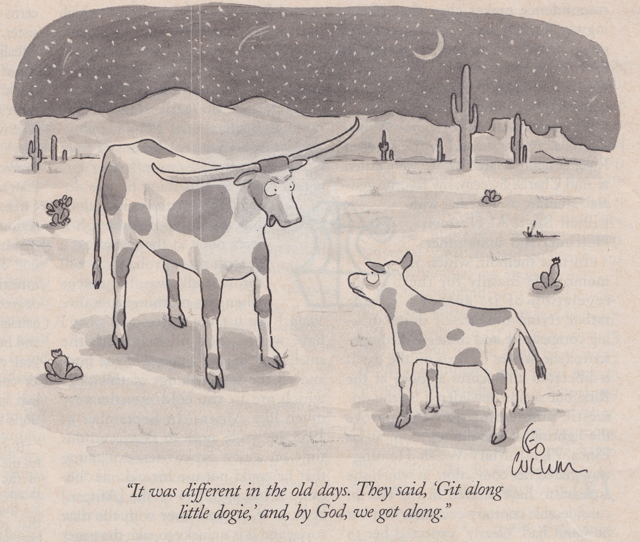
I have held on to this New Yorker cartoon for over a decade. It cracks me up every time I stumble across it in my stuff as I did today. (As with all New Yorker cartoons, some people will get it, some won't.)

Scan

P.S. I searched my blog to see if I had posted this before. In any case, enjoy.

Thursday, October 6, 2011

Spontaneous? Really?

During a press conference this afternoon, House minority leader Nancy Pelosi had this to say about the Wall Street occupiers:

"God bless them for their spontaneity. It's independent . . . it's young, it's spontaneous, and it's focused."

Spontaneous? Really?

I heard something in the news today that led me to check the domain name registration information for two of the main web sites being used by the protestors:

occupywallstreet.org was registered on June 9

occupywallst.org was registered on July 14

Looks like somebody was planning these protests long before they spontaneously occurred.

Wednesday, October 5, 2011

The Leaves They Are a'Changin'

Early photos (taken Oct. 5) of the leaf changes along the Blue Ridge Parkway in Western North Carolina: Mt. Mitchell, the Linville viaduct, Grandfather Mountain, etc. Just a foretaste of what's to come. Link.

Friday, September 30, 2011